

What Exactly Are You Stress-Testing?
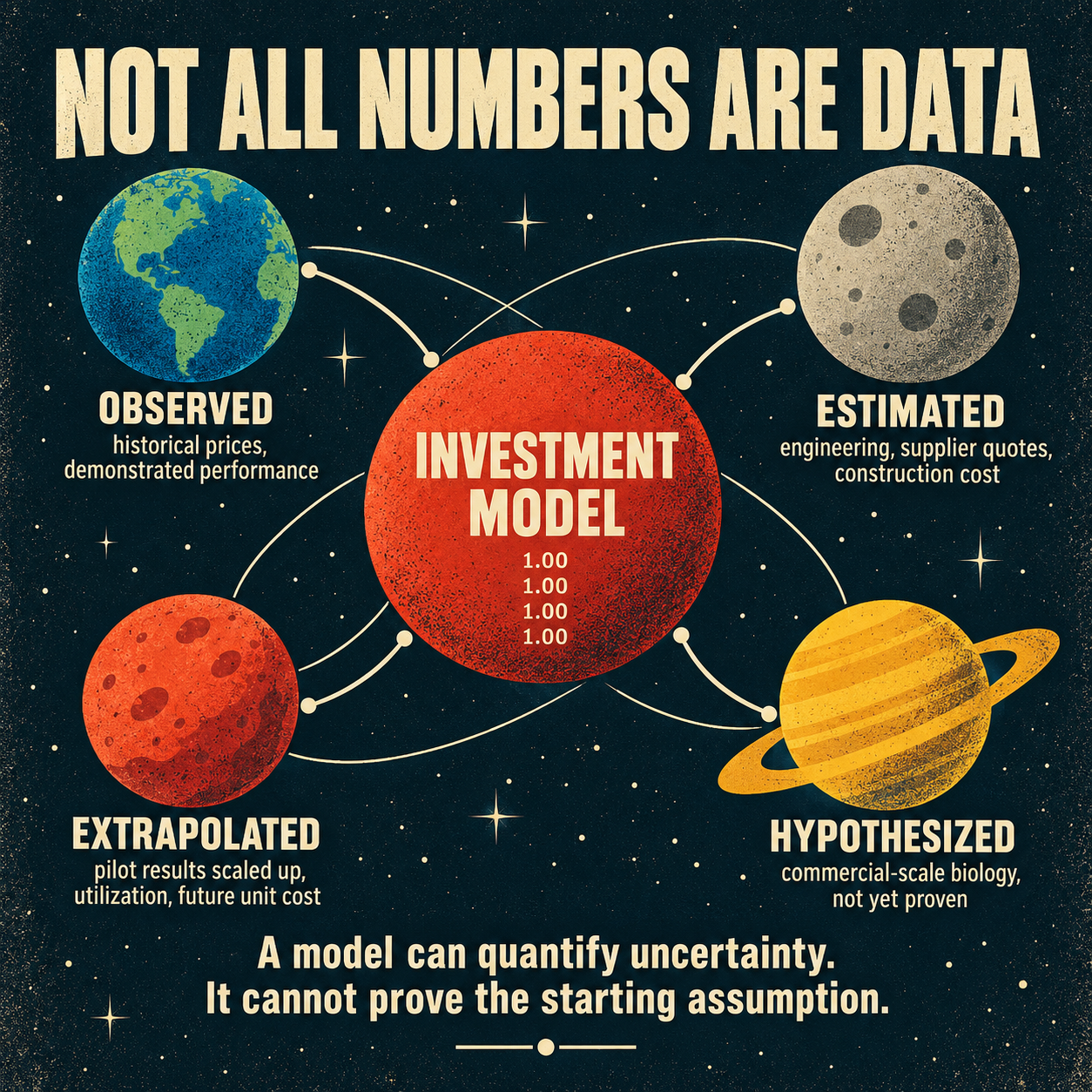
What Atlantic Sapphire and Gigante Salmon tell us about false precision in early-stage aquaculture investing.
Any competent investor looking at an early-stage aquaculture project will run sensitivities. What happens if salmon prices fall 15%? If construction costs rise 20%? If production reaches only 80% of nameplate? If operating cost is NOK 10/kg higher than forecast?
That is standard investment analysis.
But sensitivity analysis contains an important assumption of its own: that the number being stressed is sufficiently well supported to represent a reasonable starting point.
In novel aquaculture, that may not be true.
A model can tell us what happens when FCR moves from 1.17 to 1.30. It cannot tell us whether 1.17 was ever a sufficiently proven commercial assumption to deserve being the centre point of that analysis.
Atlantic Sapphire provides a striking example.
In 2018, the company described its Danish operation as a 3,000-ton HOG “commercial pilot” and pointed to more than seven years spent developing full-cycle land-based salmon production. Alongside it sat a much larger ambition in Florida: 90,000 tons of annual production developed in three phases.
The financial model was reassuringly precise. Phase 1 was projected at 9,484 tons, rising ultimately to 89,418 tons. Economic FCR was assumed at exactly 1.17 through every phase, alongside equally specific assumptions for electricity, oxygen consumption and operating performance.
The evidence beneath those assumptions was rather less substantial. The same presentation showed Danish harvests of only 59 tons in 2016, 212 tons in 2017 and 510 tons in 2018. Atlantic Sapphire also explicitly warned that land-based salmon was a new industry, that its commercialization strategy could fail and that it had already experienced a mass-mortality event.
None of this was hidden from investors. The question is whether it was interpreted correctly.
Atlantic Sapphire had demonstrated something important: Atlantic salmon could be grown to harvest in a full-cycle land-based system. What it had not demonstrated was that biological and operational performance could be reproduced predictably at tens of thousands of tons.
That is not simply a wider sensitivity range. It is a different category of uncertainty.
An analyst might reasonably have stressed FCR from 1.17 to 1.30 or 1.40 and regarded the resulting model as conservative. But if performance at 90,000 tons had never been demonstrated, the more fundamental question was whether 1.17 was an operating assumption at all, or still a hypothesis about what scale would deliver.
Proof that something can work is not proof that it can be repeated economically at scale.
Gigante Salmon illustrates the same analytical problem from a different direction.
Its proposition carried a different kind of reassurance. The project was being developed within an established Norwegian salmon-farming cluster using technology that was, individually at least, familiar to the industry. The 2021 investment material put construction of the Rødøy facility at NOK 445 million, including a NOK 65 million buffer, for approximately 16,000 tons of eventual annual production.
An investor could quite reasonably have taken NOK 445 million, added another 10%, 15% or 20% in a downside case and concluded that construction risk had been adequately stressed.
But that assumes NOK 445 million was already a mature estimate of a substantially defined asset.
The company's own information document identified design and engineering changes as potential sources of cost overruns. And the design continued to develop after investors had committed. In 2022 Gigante was still working to complete critical design activities needed to support procurement, while changes including a rockfill and secondary wastewater-treatment capability were being incorporated into the project.
Again, the issue is not that management should somehow have known the final cost in advance. Early estimates are necessarily uncertain.
The issue is what degree of confidence investors attached to the estimate.
A 15% contingency around a substantially completed design is meaningful. A 15% contingency around a project whose engineering and scope are still evolving may provide an illusion of protection. The uncertainty is not simply whether known items cost more than expected. It includes uncertainty over what ultimately has to be built.
This is where spreadsheets can create false confidence.
Once NOK 445 million or an FCR of 1.17 enters a model, it starts to look like data. Analysts can sensitise it, calculate IRRs and produce elegant downside cases. The mathematics may be impeccable while the underlying evidence remains immature.
The better starting point for novel aquaculture investments may therefore be to distinguish between what is observed, what is estimated, and what is still extrapolated.
Historical salmon prices are observed. A construction cost assembled from completed engineering and firm quotations is an estimate. Biological performance projected at 90,000 tons from experience measured in hundreds of tons is an extrapolation.
Those numbers should not enter an investment model carrying the same weight simply because they all fit neatly into a cell.
This does not make sensitivity analysis less important. It makes understanding the evidence behind the base case more important.
In established industries, an investor can often assume that the centre of the range is reasonably well understood and concentrate on what happens around it. In genuinely novel projects, the centre itself may still be moving.
That, in hindsight, may be one of the most important lessons from Atlantic Sapphire and Gigante Salmon.
Before asking what happens if the number is wrong, ask how much reason you had to believe the number in the first place.