

My last article, When a 4x Return Isn't Enough, explored how the probability of achieving a business plan can dramatically change the attractiveness of an aquaculture investment. A project offering a potential 4x return became considerably less compelling when we considered the possibility of underperformance or outright failure.
It got me thinking about the broader range of outcomes investors should consider, and how they might establish reasonable probabilities for each.
At the most optimistic end of that spectrum is transformative success.
Many pioneering aquaculture developments promise more than profitable production. They propose to overcome constraints that have historically limited industry growth, potentially creating opportunities far greater than the original business plan contemplates.
It's a legitimate investment proposition. A relatively low probability of success might be acceptable if the potential reward is sufficiently extraordinary. But what would transforming an industry actually look like, how likely is it, and what would it take for the pioneering investors to benefit?
What Are We Transforming?
Land-based salmon farming provides a useful example.
The proposition isn't simply that salmon can be grown in tanks. It is that commercially competitive land-based production could remove the geographic and regulatory constraints that have historically limited the expansion of conventional salmon farming. If successful, the opportunity could be enormous.
But demonstrating that salmon can be produced in a land-based facility is not the same as demonstrating that the model can be replicated economically. Nor does demonstrating a profitable facility necessarily mean that an entire industry will transform.
Investors need to distinguish between these possibilities.
Can the proposed production system reliably achieve its biological targets? Can subsequent facilities be constructed and operated at competitive costs? Are the necessary infrastructure, regulatory approvals and commercial arrangements available? And does success depend on other developments over which the project promoter has little control?
A project might have a reasonable prospect of proving its technology while having a much lower probability of transforming the industry. That distinction matters enormously when transformative growth is being used to justify a substantial investment premium.
What Does the Pioneering Investment Create?
The first investors in a novel production system do more than finance physical assets. Their capital pays for engineering development, operational learning, regulatory approvals and the resolution of uncertainties that subsequent developers may never encounter.
That experience can have considerable commercial value.
But who owns it?
Years ago, while working for a private equity-owned seafood company, I frequently heard an investment adage whose message was simple: Pioneers bear the risks; followers reap the rewards. It's particularly relevant to aquaculture.
Much of the knowledge acquired by a pioneering operation can eventually spread through employees, contractors, equipment suppliers and consultants. Competitors may benefit from the pioneer's investment without sharing the cost of acquiring that experience. The original developer might possess valuable intellectual property, privileged market access, regulatory advantages or an operating system that is difficult to replicate.
Alternatively, its supposed first-mover advantage might amount to being the first company to pay for mistakes that everyone else can subsequently avoid. For an investor evaluating the probability of extraordinary success, the distinction is critical.
Demonstrating a breakthrough is valuable. Retaining a competitive advantage because of that breakthrough is something else entirely.
What Does the Transformed Industry Look Like?
There's another question that I suspect is frequently overlooked. What happens to industry economics if the promised transformation actually succeeds?
Consider the implications of removing constraints on salmon production. The scarcity of conventional marine farming licenses helps restrict the industry's ability to increase supply. That scarcity contributes to the economic value of existing production assets.
If land-based farming makes substantial additional production commercially viable, the resulting supply growth could put considerable pressure on salmon prices.
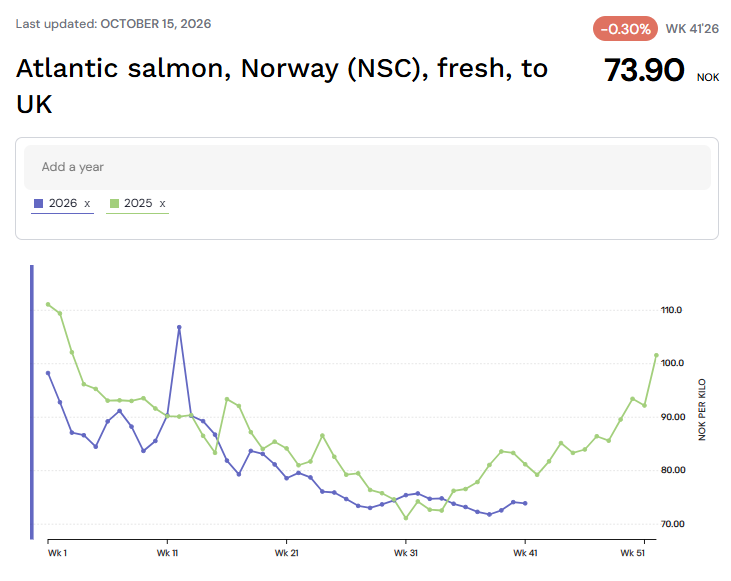
2025 and the first half of 2026 demonstrated how sensitive salmon prices can be to relatively modest changes in industry supply.
Now consider an investment thesis predicated on removing one of the industry's principal constraints on growth.
Can investors reasonably assume that the pricing environment supporting their business plan will survive the transformation they're financing?
Perhaps the new technology will also deliver sufficiently lower production costs to maintain attractive returns at reduced selling prices. But that needs to be demonstrated, not assumed. Otherwise, the transformation could create enormous value for consumers while undermining the profitability of the businesses responsible for delivering it.
A revolutionary production system doesn't necessarily create a revolutionary return on investment. It might simply introduce another competitor into an increasingly competitive commodity market.
What Does Exploiting the Opportunity Require?
Even if the technology works, the market expands and the pioneer retains a competitive advantage, the original investors face another challenge.
Aquaculture production is capital intensive. Exploiting a transformative opportunity generally requires additional facilities, equipment, biological inventory and substantial working capital. A successful initial investment might therefore create an opportunity requiring many times the original capital commitment to exploit.
Project proponents need to think about that financing journey from the outset.
Can subsequent facilities be constructed more economically? Does the operating platform become more efficient as production increases? Can expansion eventually be financed through retained earnings and debt, or will it require successive rounds of equity? Rapid expansion may be essential to establishing a competitive position before others exploit the same opportunity. But financing that growth can also progressively dilute the ownership of the investors who funded the original breakthrough.
Alternatively, the pioneer might sell its business or technology to a better-capitalized operator. That could deliver an excellent return without requiring the original investors to finance the entire expansion.
Either approach can work. Neither is guaranteed.
Three Different Probabilities
For an investor attracted by the prospect of transformative success, I think there are three distinct questions.
What is the probability that the pioneering business demonstrates a commercially successful breakthrough?
Assuming it does, what is the probability that the breakthrough actually transforms the industry's growth prospects and economics?
And if that transformation occurs, what is the probability that the pioneering business — and its original investors — capture enough of the resulting value to justify the risks they accepted?
These aren't independent questions, and assigning precise probabilities may be difficult. But they expose the assumptions underlying a transformative investment proposition. They should also encourage project promoters to think beyond delivering the first successful facility. The strategy for exploiting a breakthrough, defending its advantages and financing expansion needs to be part of the original investment thesis.
The greatest risk to a transformative investment may not be that the innovation fails. It may be that the innovation succeeds, transforms the industry, and leaves the pioneers with surprisingly little of the value they helped create.