

Density Headroom Ratio: Biology Isn’t the Risk You Think It Is
Why headroom matters more than health.
If you’re looking at the Atlantic salmon industry as an investment, your choices are more constrained than they first appear.
Open net pens remain the dominant global production system. They are the lowest-cost way to produce salmon at scale, operationally well understood, and — from a biological standpoint — relatively forgiving. Their primary risks are largely external: social license, public perception, and the possibility that regulation tightens faster than economics can adapt.
Every alternative system — land-based flow-through, hybrid designs, full recirculating aquaculture systems (RAS), and vessel-based concepts — exists to solve real problems. But they do so at meaningfully higher cost and by operating at much higher biological intensity.
That trade-off is where most investors underestimate risk.
How we’ve been trained to think about biological risk
When investors hear “biological risk” in salmon farming, the mental checklist is familiar: Sea lice. Viruses. Plankton blooms. Algal events.
Decades of media coverage and industry experience have trained us to associate biological risk with external shocks — things that happen to farms.
Closed-containment and land-based systems genuinely reduce many of these risks. They isolate fish from the marine environment, eliminate lice exposure, and and allow tighter control over intake water quality and environmental exposure.
But eliminating exposure does not eliminate biology. It changes where risk lives.
Salmon performance degrades long before salmon die
Atlantic salmon are remarkably efficient animals — and remarkably sensitive ones. Fish do not need to die for value to be destroyed. Subtle environmental stressors degrade performance well before mortality appears:
Oxygen levels that are too low — or too high
Carbon dioxide accumulation
Nitrogen compounds and metabolites
Crowding and behavioral stress
From an investment perspective, this distinction is critical:
Salmon performance deteriorates long before salmon die.
A system can report strong survival, minimal disease, and still quietly erode value through lost growth, early harvests, and poor size distribution. This is the biological risk most decks don’t model.
Why density matters more than most investors realize
As production systems become more intensive, biological risk becomes less about disease and more about proximity to tolerance limits. Low-density systems operate with slack. High-density systems do not.
The closer a system operates to the point where fish performance begins to degrade, the less room there is for forecasting error — whether conditions turn out slightly better or slightly worse than expected.
This is where a simple mental model becomes useful.
Introducing the Density Headroom Ratio (DHR)
One way to think about biological risk in intensive aquaculture is not mortality, but headroom.
Specifically: how much room exists between normal operating conditions and the point where fish performance begins to deteriorate.
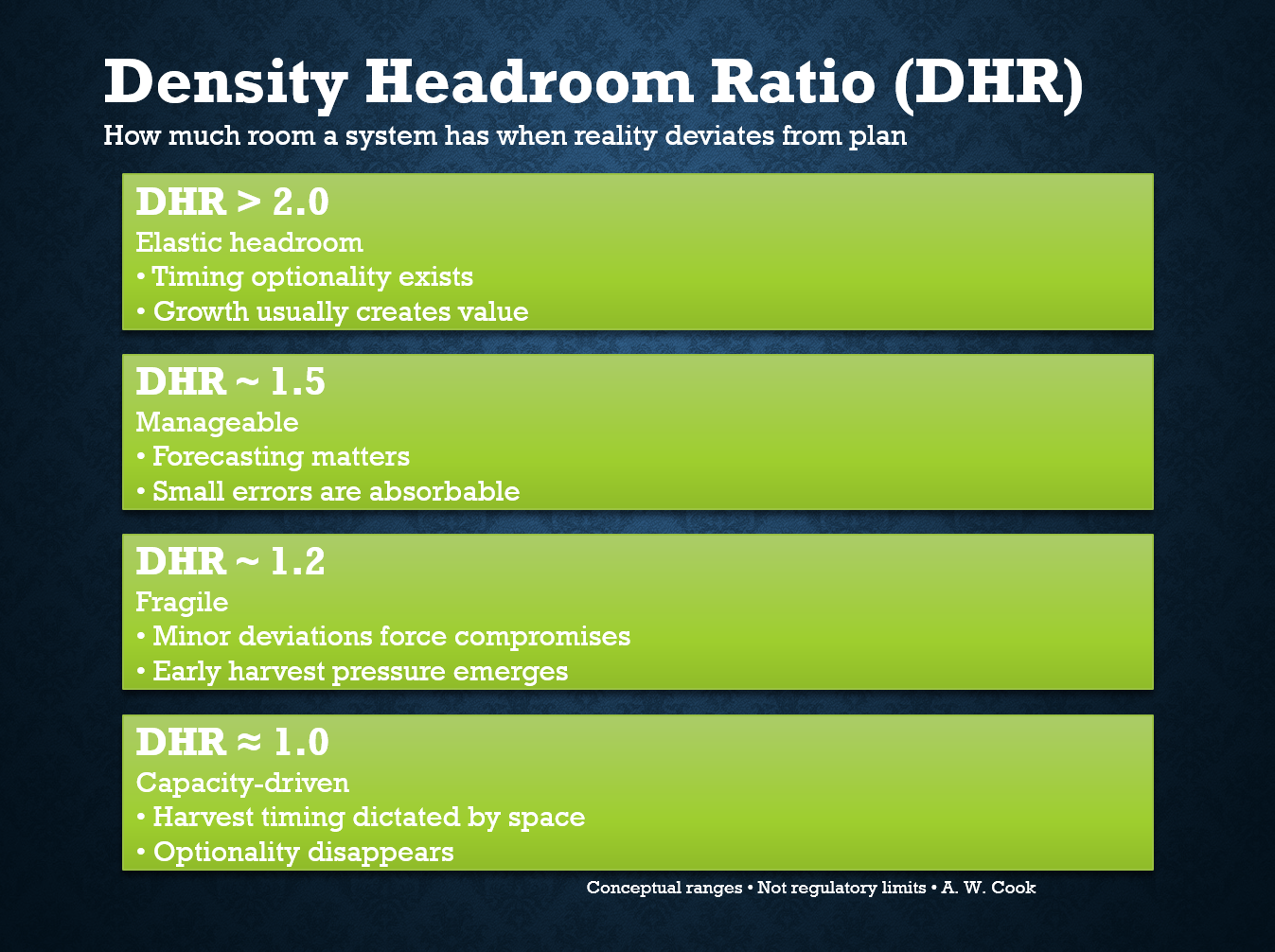
I find it useful to frame this as a Density Headroom Ratio (DHR):
Density Headroom Ratio (DHR) = density at which fish performance deteriorates ÷ typical operating density
This is not a regulatory limit or a design specification. It’s the point where biology stops cooperating economically.
As a rough guide:
DHR > 2.0 → meaningful slack; timing optionality exists
DHR ~ 1.5 → manageable, but forecasting matters
DHR ~ 1.2 → fragile; small deviations force compromises
DHR ≈ 1.0 → harvest timing becomes capacity-driven, not market-driven
The lower the ratio, the faster optionality disappears.
The paradox most investors never stress-test
Here’s the uncomfortable scenario most financial models ignore:
What happens if fish grow faster than expected?
In low-density systems, faster growth is usually good news. In high-density systems, faster growth can shorten the runway.
Biomass grows non-linearly. System limits do not.
When operating close to tolerance thresholds, a modest acceleration in growth can:
Pull forward the date at which density ceilings are reached
Compress harvest windows
Force early harvests unrelated to market conditions
This is how systems end up harvesting smaller fish even when biology looks “good.” At that point, harvest decisions are no longer driven by price or demand — they are driven by space. And once harvest timing becomes capacity-driven, optionality disappears very quickly.
Why this risk hides in plain sight
This failure mode rarely shows up as a dramatic biological event.
Instead, it appears quietly as:
Lower average harvest weights
Early or uneven harvests
Rising fillet share
Erosion of pricing power
From the outside, biology appears under control. From the inside, the system has simply run out of room.
What investors should actually be worried about
None of this is an argument that one production system is “good” and another is “bad.” It is an argument that different systems fail in different ways. High-intensity systems tend not to fail catastrophically. They fail economically — through timing pressure, constrained decision-making, and lost optionality — long before fish start dying.
For investors, the relevant question is not simply:
“Is the biology good?”
But rather:
“How much margin for error does this system have, and how quickly does that margin disappear when reality deviates from plan?”
The diligence question that matters
If you are evaluating an aquaculture investment, ask this — and insist on a clear answer:
At what density does fish performance begin to deteriorate, and how close does the system normally operate to that point?
If the answer is vague, the headroom is probably smaller than the deck implies.
And when headroom disappears, optionality follows.
Next in this series: Density headroom is not the whole story. Two systems can operate at similar densities and face very different levels of risk depending on how quickly they can recover when reality deviates from plan.