

The Throughput Ceiling
Operational Signals That Define Real Working Capacity
Most underwriting conversations around high-intensity aquaculture focus on familiar metrics: mortality, FCR, harvest volume, EBITDA progression. Those are outcome measures. They tell you what happened.
They do not tell you how close the system is operating to its functional limits.
High-intensity systems rarely fail abruptly. More often, they drift into constraint. Throughput stabilizes slightly below plan. Harvest weights settle a bit under model. Operating effort increases. None of this necessarily looks dramatic in a quarterly report.
The drift is visible operationally long before it is visible financially.
Investors do not need to master the engineering. But they do need to know what to ask the operations team to determine whether a facility is operating with margin — or at its margin.
Oxygen
Oxygen is a good place to start. Fish experience post-feeding oxygen troughs as metabolic demand rises. That is normal physiology. The useful question is not whether troughs occur, but how they evolve as biomass increases. When do minimum oxygen levels occur relative to feeding? Do troughs deepen at similar biomass levels across cycles? Does the system fully reset between feeding events late in the cycle? If the oxygen system is routinely operating near maximum output during normal feeding windows at peak biomass, control authority is thin. Assets that operate at full capacity during routine conditions leave little room for disturbance.
The issue is not whether individual fish recover quickly from stress. In fixed-volume systems, what changes late-cycle is aggregate demand relative to installed processing capacity. As biomass increases within a fixed volume, the oxygen reserve per kilogram declines. The system has less buffer and less time to absorb disturbance. In open systems such as net pens, biological sensitivity may dominate. In high-intensity systems, demand density dominates. That distinction matters for underwriting.
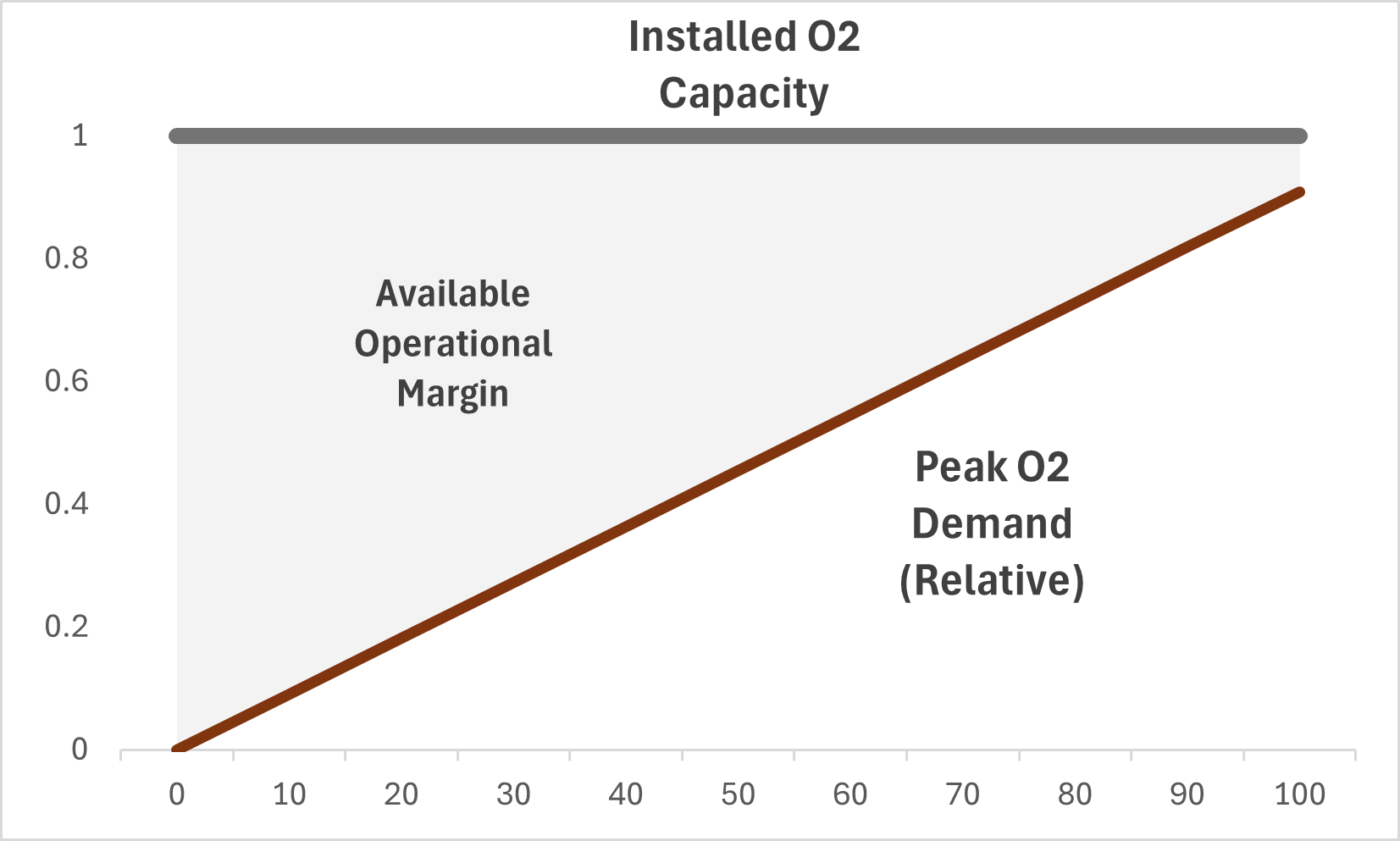
Oxygen is shown as a representative constraint. The same ceiling logic applies to CO₂ stripping, biofiltration, and solids removal.
Carbon Dioxide
Carbon dioxide can be more subtle. Fish can remain within oxygen specification while CO₂ levels gradually rise as density increases. The biological consequence is rarely immediate mortality. It is moderated appetite, slower growth, and stress sensitivity. The relevant question is whether post-feeding CO₂ peaks remain stable cycle-over-cycle at similar biomass, or whether they drift upward. It is also useful to ask what operational adjustments are required to maintain CO₂ within target at peak density. If maintaining control requires progressively higher blower speeds, altered flow rates, flattened feeding curves, or periodic density relief, stability is being actively managed rather than structurally embedded. The same ceiling logic that governs oxygen applies to CO2 stripping: biological load increases while installed processing capacity remains fixed.
Solids and Waste Removal
Solids and waste removal deserve equal attention. Feed becomes fish, but it also becomes waste. In high-density systems, solids must be removed continuously. If removal capacity lags production, solids can accumulate gradually: water clarity declines, fine particulates increase, gill irritation rises, appetite moderates, cleaning burden grows. Investors do not need to understand micron ratings or hydraulic loading curves. They should ask whether water clarity changes meaningfully as biomass approaches peak levels. Do downstream “clean water” areas accumulate settled solids late-cycle? Has there been any drift in gill health metrics across cycles at similar densities? Solids where they are not expected are rarely benign. They are often a signal that clearance margin is narrowing.
Feeding Behavior
Feeding behavior provides another useful lens. In tightly utilized systems, operators may adjust feeding rhythms to protect stability — flattening feed curves to reduce oxygen spikes or CO₂ peaks. That can be good operational discipline. It can also signal that the system is operating close to its peak handling capacity. Asking whether feeding patterns have been progressively adjusted as biomass increases is often more revealing than asking whether FCR remains “on target.”
Harvest Weights
Harvest weight consistency is where biological constraint becomes economic reality. One successful harvest at modeled weight proves little. The more important question is whether harvest weights are consistently achieved across cycles at peak density. Persistent 5–10 percent shortfalls often reflect density management or early harvest to relieve load. Early harvest can be rational and disciplined. But when harvest timing becomes space-driven rather than market-driven, revenue optionality narrows. That is an economic consequence of biological constraint.
Establishing Real Working Capacity
A useful synthesis question for any investor visit is simple: as biomass approaches peak levels, what parameter becomes uncomfortable first? Is it oxygen trough depth, CO₂ peaks, water clarity, gill scores, cleaning effort, appetite, or size distribution? Whatever tightens first defines the system’s working capacity. That constraint – not the nameplate specification – sets the economic ceiling.
None of these questions are accusations. They are calibration tools. High-intensity aquaculture does not primarily fail through catastrophe. It converges through constraint. Constraint shows up first in operational detail: deepening oxygen troughs, rising CO₂ peaks, visible solids accumulation, increased cleaning effort, feeding adjustments, moderated harvest weights.
In fixed-capacity systems, margin compresses before performance collapses.
Financial models detect constraint late. Operational signals reveal it early.
Investors underwriting capital-intensive biological systems should not ask only whether the fish are surviving. They should ask whether the system operates with demonstrable margin at peak biomass, repeatably, across cycles.
If you only ask about mortality, you are asking too late.