

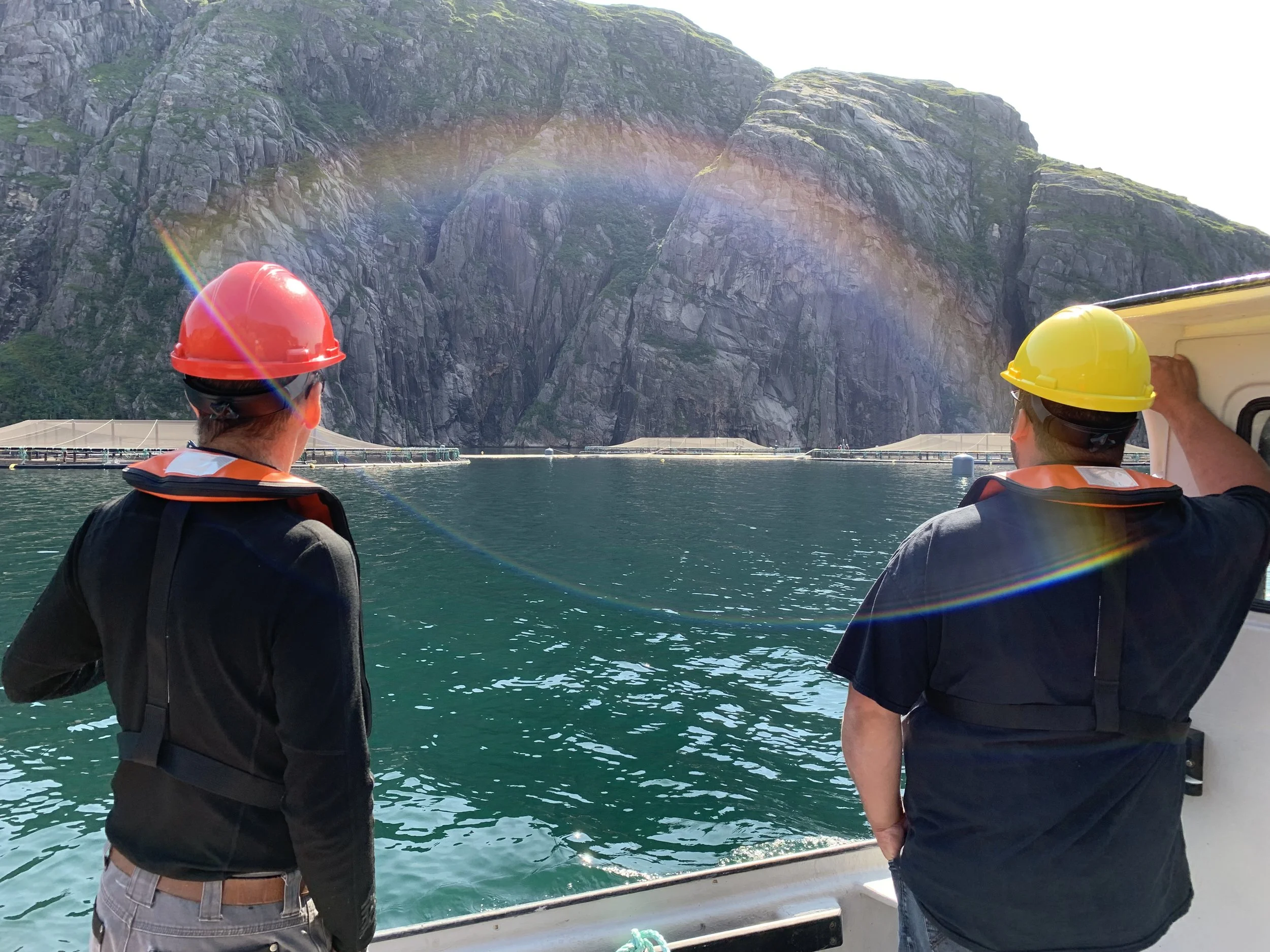
Salmon farmers looking into the future.
For most of my career, I've worked in salmon aquaculture. And for much of that time, I've tended to think that salmon was where the real money was made in fish farming. My assumption was fairly straightforward. The most attractive aquaculture businesses would be those producing high-value fish, selling into relatively wealthy markets, with supply constraints helping to sustain premium prices. Salmon seemed to fit that description particularly well.
I was certainly aware of the enormous industries producing shrimp, tilapia, pangasius and other species. I just hadn't given them much serious consideration as investment opportunities. Over the past few years, however, I've had many conversations about those species that have challenged my assumptions about what makes an aquaculture investment financially attractive. Combined with my recent thinking about the economics of new salmon investments, they've led me to a question I hadn't really considered before.
Has my focus on salmon caused me to overlook some excellent investment opportunities elsewhere in aquaculture?
The salmon investment paradox
For much of the past decade, established salmon producers have enjoyed exceptional profitability. Understandably, investors have been eager to participate. But there's an important distinction between investing in a profitable industry and finding an attractive investment opportunity within it. Norwegian salmon farming has become a mature industry with substantial barriers to entry. Its profitability reflects decades of accumulated expertise, infrastructure, market development and, importantly, regulatory constraints on production capacity.
For new investors, those advantages create something of a dilemma.
One option is to buy an established producer. But access to existing farming capacity comes at a substantial price. SalMar's 2026 agreement to acquire Måsøval, for example, valued the company's equity at approximately NOK 4.8 billion, despite a challenging recent operating history. Such valuations may make sense for established producers able to extract synergies, consolidate operations and reduce costs. Whether they offer similarly attractive returns to financial investors is another question.
The alternative is to create new production capacity.
But circumventing the constraints on conventional salmon farming often requires enormous investments in infrastructure. To generate competitive investment returns, these new systems must achieve operating efficiencies sufficient to offset their much higher capital costs.
And even if they succeed, they still have to sell salmon into the same market as established producers.
That market has recently provided a rather uncomfortable reminder of its sensitivity to supply. In 2025, global Atlantic salmon production increased by approximately 12%, while Norwegian reference prices declined by more than 14%. Much of the additional supply resulted from improved biological performance within existing farming operations, rather than the development of substantial new production capacity. Regulatory constraints on the number of licenses do not necessarily translate into predictable constraints on the volume of salmon entering the market.
This presents an awkward problem for investors whose business plans were developed around expectations of permanently constrained supply and steadily increasing prices. The salmon industry may remain highly profitable over the long term. But new investors must either pay substantial prices to acquire existing competitive advantages or commit enormous capital to developing alternatives, often without the benefit of established production economics.
Perhaps salmon has reached a point in its development where the opportunities to capture early-industry returns are largely behind us.
That doesn't mean there aren't attractive salmon investments remaining. But it does suggest that investors may need to be much more selective about where they expect additional value to come from.
Looking beyond salmon
This line of thinking recently prompted me to do some reading about successful businesses in other aquaculture industries.
Two companies particularly caught my attention.
The first was Vinh Hoan, a Vietnamese pangasius producer. In a 2017 interview, its founder, Truong Thi Le Khanh, described starting the business in 1997 with just VND 70 million, approximately US$5,000 at historical exchange rates. She rented a processing facility, employed 70 people and purchased fish from local farmers. Her customers were prepared to buy everything she could produce, while suppliers extended credit until export proceeds arrived.
According to her account, the business initially operated without borrowing from banks.
Almost three decades later, Vinh Hoan is a substantial international aquaculture business, generating approximately VND 12 trillion in annual revenue and VND 1.4 trillion in net profit attributable to shareholders in 2025. Between 2014 and 2025, total assets nearly tripled while outstanding borrowings remained approximately unchanged. Accumulated profitability appears to have played an increasingly important role in financing growth.
The second company was Industrial Pesquera Santa Priscila in Ecuador.
Its founder, Santiago Salem, began shrimp farming in 1978 with a 64-hectare operation employing 18 people. Over the following decades, he developed a business that became one of the world's largest shrimp producers. In 2023, Mitsui invested US$360 million for a 20% interest in its holding company, implying an equity valuation of approximately US$1.8 billion.
I don’t know enough about either company's history to offer a definitive explanation of its success. Both have faced considerable biological, commercial and financial challenges, and Santa Priscila's early financing history deserves further investigation.
But their development illustrates something that I find intriguing.
Neither depended on creating a new market for an exotic species or developing a revolutionary production technology. Both started with relatively modest operations using commercially understood production systems, then progressively developed the capabilities and competitive advantages that allowed them to become substantial businesses.
They didn't need to discover a more valuable fish. They needed to build a more valuable business.
Where should investors look next?
The more I've thought about these examples, the more I've questioned whether the profitability of an established industry is a particularly useful starting point for identifying new investment opportunities.
An investor buying into Norwegian salmon farming today is paying for competitive advantages developed over decades. An investor financing a new production system is betting that those advantages can be replicated, or overcome, at a cost that still provides an attractive return.
Neither is necessarily a bad investment. But neither should be confused with the opportunities available to entrepreneurs who helped build the industry in the first place.
Vinh Hoan and Santa Priscila demonstrate that substantial value can also be created in less glamorous aquaculture industries, sometimes beginning with relatively modest amounts of capital. Their success doesn't make pangasius or shrimp inherently attractive investments, but it certainly challenges my assumption that salmon deserves to be the center of the investment universe.
Perhaps we should be asking less about which aquaculture industries are generating the greatest profits today, and more about where the next dollar of investment has the greatest opportunity to create value.
After spending most of my career looking at aquaculture through a salmon-coloured lens, I'm beginning to think those might be very different places.