

I was talking with a Norwegian colleague this week about the cost of feed in salmon aquaculture compared with poultry production. In poultry farming, feed typically represents around 70% of total production costs. In salmon farming, it's closer to 40%.
His immediate reaction was that salmon farmers probably weren't spending enough on feed. There was considerable opportunity, he suggested, to invest in better diets and improve biological performance. My reaction was rather different. Perhaps salmon farmers were spending too much on everything else.
But the more I thought about it, the more interesting the question became.
How much further can salmon producers realistically reduce their operating costs?
This is particularly relevant to land-based salmon farming, where several producers are reporting excellent survival, feed conversion, growth and harvest quality. If biological performance is already approaching practical limits, where will further operating-cost savings come from? And could those savings be sufficient to give land-based producers a cost advantage over conventional net-pen farming?
The Physics of Water
A modern poultry barn is a sophisticated production environment. Temperature, ventilation, lighting, feeding and watering are closely controlled. Decades of refinement have made poultry production extraordinarily efficient.
Land-based salmon farming shares many of these objectives. But there is one fundamental difference.
Water is not air.
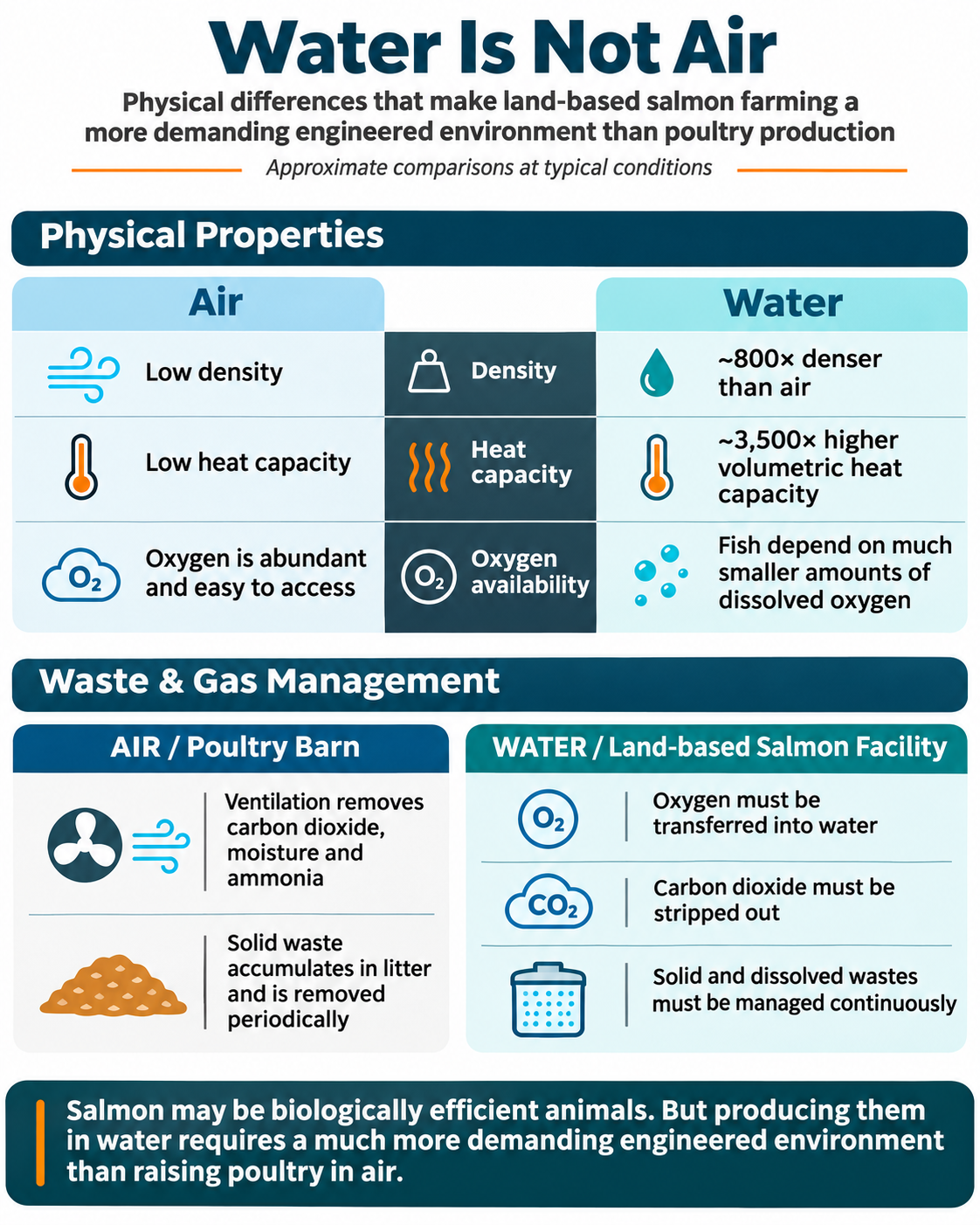
Water is approximately 800 times denser than air. A cubic metre of water has roughly 3,500 times the heat capacity of a cubic metre of air. And while air contains abundant oxygen readily available to chickens, fish depend on the much smaller quantities dissolved in water. These physical differences have profound implications for the engineering required to maintain a suitable production environment.
In a poultry barn, ventilation replaces contaminated air with fresh air, removing carbon dioxide, moisture and ammonia. Solid waste accumulates in bedding and can be managed throughout the production cycle and removed periodically. In a land-based salmon facility, oxygen must be transferred into water, carbon dioxide removed, and solid and dissolved wastes managed continuously.
In a recirculating aquaculture system (RAS), mechanical filters remove solids, biological filters process ammonia, and degassing systems remove accumulated carbon dioxide. These systems operate continuously, consuming energy and requiring maintenance. Flow-through facilities avoid much of this treatment equipment by replacing water rather than recycling it. But that requires sourcing, moving and potentially treating large volumes of incoming and outgoing water.
Temperature presents another challenge. Water's enormous thermal capacity provides valuable stability, but changing its temperature requires considerable energy.
The engineering solutions differ considerably, but the underlying physical requirements remain.
The Advantage of the Ocean
A conventional net-pen farm relies on the surrounding ocean to perform many of these functions.
Natural water exchange replenishes oxygen, removes carbon dioxide, disperses dissolved metabolic waste and provides a relatively stable thermal environment.
In effect, net-pen farming externalizes part of the cost of waste management to the surrounding environment. This is not inherently unsustainable. Marine ecosystems have a natural capacity to assimilate organic waste and dissolved nutrients, provided farming activities remain within that capacity and do not cause unacceptable environmental impacts.
Of course, the ocean also introduces biological challenges that land-based facilities are designed to avoid. Sea lice, pathogens, harmful plankton and adverse environmental conditions impose substantial costs on conventional salmon farming. But avoiding these problems requires accepting the costs of creating and maintaining a controlled environment.
A land-based producer must engineer many of the environmental services that the ocean provides naturally.
How Much Room Is Left?
There are opportunities to improve the operating efficiency of land-based facilities. Better hydraulic design, gravity-assisted water movement, improved treatment technologies, automation and heat recovery can all reduce costs. Faster production cycles and greater capacity utilization can also spread fixed costs over more kilograms of fish.
But there are practical limits.
A facility achieving 98% survival cannot improve survival by another five percentage points. A biological FCR of 1.10 leaves relatively little room for further reductions in feed consumption. Meanwhile, the pumps, filters, oxygenation and other environmental-management systems must continue operating. This doesn't mean land-based salmon farming cannot achieve competitive operating costs. It means that excellent biological performance, by itself, is insufficient evidence that it will.
Salmon are extraordinarily efficient animals. But there is an important distinction between the biological efficiency of an animal and the operating efficiency of the system used to produce it. Better biology can improve the economics. Better engineering can reduce costs. Greater production volume can spread those costs over more fish.
But the physical properties of water are not going to change.
If leading land-based salmon facilities are already approaching excellent biological performance, how much further can their operating costs realistically fall—and where, specifically, will those savings come from?