

My last article, What If the Breakthrough Works?, explored the most optimistic outcome for an aquaculture investment: a successful innovation that creates opportunities far greater than the original business plan contemplated.
But what about the considerably more conventional outcome of simply delivering the plan?
In When a 4x Return Isn't Enough, I explored how the probability of different outcomes can dramatically change the attractiveness of an investment. That raises an important question: how should an investor assess the likelihood that a business will actually achieve its forecasts?
Aquaculture investment proposals frequently contain detailed predictions of production volumes, growth rates, survival, feed conversion, operating costs and profitability, supported by sophisticated financial models. But while the financial outcomes may be presented with considerable precision, the evidence supporting their achievement can be much less convincing.
A business plan describes what management expects to happen. It doesn't establish the probability that it will.
What Has Actually Been Demonstrated?
Consider an established tilapia producer proposing to expand a farming operation it has managed profitably for several years. An investor can examine actual production cycles, biological performance, operating costs and market returns. Expansion introduces risk, but the underlying production model has been demonstrated commercially.
Now consider a novel production system where individual components have been tested, but the integrated facility has never operated at the proposed scale.
Both businesses might present equally detailed forecasts. Yet the evidence supporting them is fundamentally different. The first is largely extrapolating from demonstrated performance. The second may depend on assumptions that have never been validated under comparable commercial conditions.
Many aquaculture developments fall somewhere between these examples. For each important assumption, investors need to establish whether it reflects demonstrated performance, reasonable extrapolation, an optimistic expectation or something approaching an educated guess.
That distinction is essential, but it is only the beginning.
Which Assumptions Matter Most?
Not every uncertain assumption carries the same economic consequences.
Consider the principal drivers of an aquaculture business plan: survival, growth rates, feed conversion, feed prices, selling prices, construction costs and the timetable for reaching full production. An investor needs to understand not only how credible each forecast is, but how much its deviation would affect the financial outcome. Some assumptions may be relatively uncertain but have limited financial consequences. Others may appear well supported, yet relatively modest deviations could substantially undermine the investment.
The direction of those deviations also matters. Lower feed prices might compensate for disappointing feed conversion, while favourable selling prices could offset higher production costs.
But biological and operational variables are rarely independent. Slower growth can extend production cycles, delay harvest revenue, reduce annual facility throughput and increase working-capital requirements. Mortality can simultaneously reduce production and increase unit costs.
For capital-intensive developments, construction and commissioning assumptions can be particularly consequential. A construction cost overrun increases the capital required before meaningful revenue is generated. A commissioning delay can add financing costs, extend the period of negative cash flow and postpone the point at which the business becomes self-sustaining.
These effects can compound, especially if the subsequent production ramp also falls short of expectations.
The critical task is to identify which assumptions carry the greatest financial consequences, how credible they are and what happens when they interact.
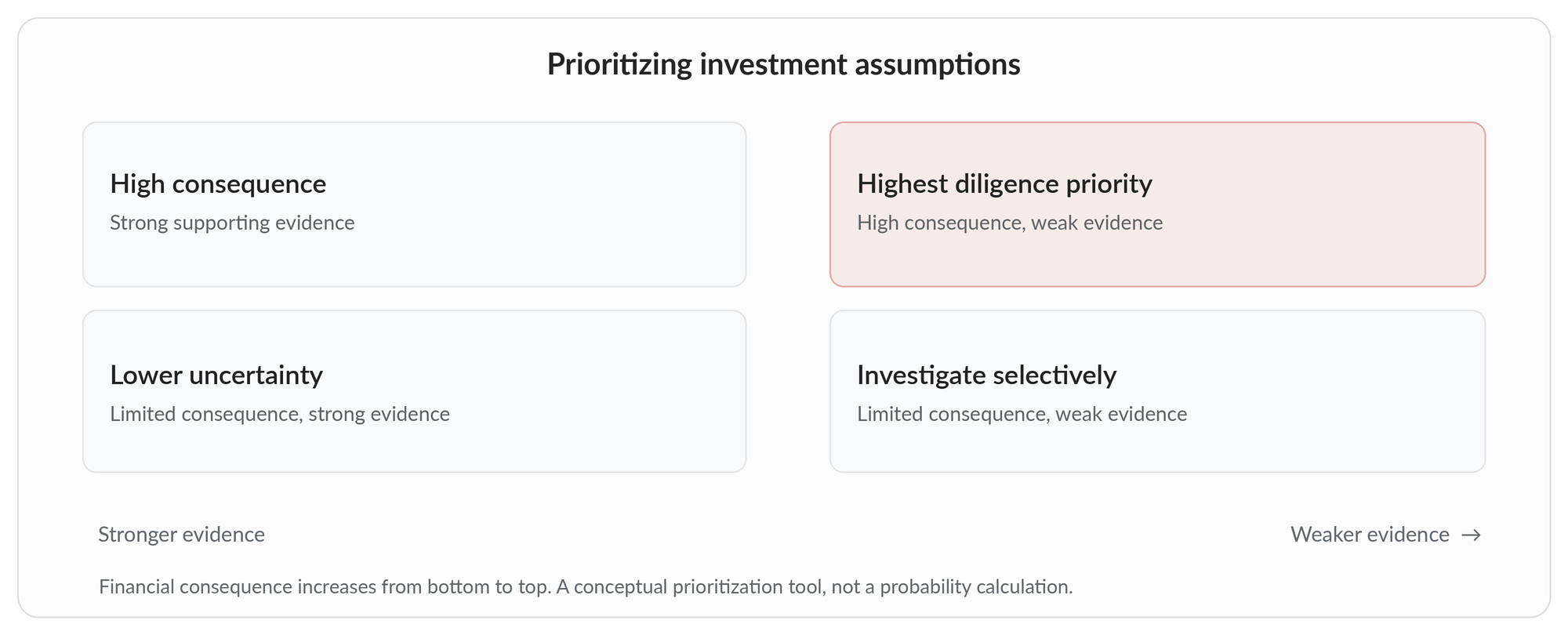
Conceptual framework for thinking about business plan elements
Do the Assumptions Work Together?
Investment firms routinely engage technical, commercial and financial specialists to assess unfamiliar businesses. An aquaculture project might receive favourable assessments from its engineers, equipment suppliers, biological consultants and financial advisers.
Each assessment may be perfectly reasonable within its own scope.
Engineers may confirm that a facility can deliver its specified capacity. Biological specialists may conclude that the proposed growth and survival rates are achievable. Equipment suppliers may validate the performance of their systems, while financial advisers confirm that the model accurately calculates the projected returns.
But each specialist may be evaluating their component under assumptions about how the rest of the operation will perform.
How has the mutual consistency of those assumptions been established? And what evidence suggests that the integrated business can deliver them together?
Equipment that performs to specification doesn't guarantee an efficiently operated farm. Biologically achievable growth rates don't necessarily represent realistic commercial expectations. And a financial model that accurately calculates projected returns provides no assurance that the production forecast supporting those calculations is credible.
Evaluating the complete operation requires an understanding of how biology, infrastructure, production management, harvest scheduling and financial performance interact. It also requires an appreciation of how commercial operations perform when conditions are less favourable than anticipated.
The distinction is between establishing that individual components are capable of performing as expected and establishing that the complete business can reasonably be expected to deliver its forecast.
What Does This Mean for Investors?
For many developing aquaculture businesses, there may be insufficient historical evidence to assign a reliable numerical probability to achieving the business plan. But that doesn't prevent a disciplined assessment. Investors can establish which assumptions are supported by commercial experience, identify those with the greatest influence on financial returns and examine the consequences of plausible deviations.
The resulting analysis may reveal that an investment is substantially less risky than initially anticipated. Equally, it may expose uncertainties that justify a lower valuation, additional demonstration work or a decision not to invest.
For project proponents, the implications are equally important.
An investment proposition is unlikely to become more credible simply because its financial model becomes more elaborate. What matters is demonstrating that the assumptions driving its financial returns are realistic, mutually consistent and supported by appropriate evidence.
The investor isn't financing a collection of technically achievable outcomes. They're financing a business expected to deliver a financial return.
The question is not simply whether each element of the business plan can be achieved, but how much confidence investors should have that the complete operation will deliver the performance on which their investment depends.