

What Was It Supposed to Cost?
In the first articles in this series, I suggested two relatively simple ways of thinking about the performance of developing aquaculture businesses. The first was Production Ramp Delivery: is the company producing the volume investors were originally told to expect? The second was Cost Ramp Delivery: are production costs converging towards the economics on which the investment case was built?
There is an equally obvious third question: did it cost what it was supposed to cost to build?
This sounds almost too simple to be useful. Companies routinely disclose construction budgets, revised budgets and eventual capital expenditure. But the original investment number has a habit of disappearing as projects move through construction, commissioning and successive rounds of financing.
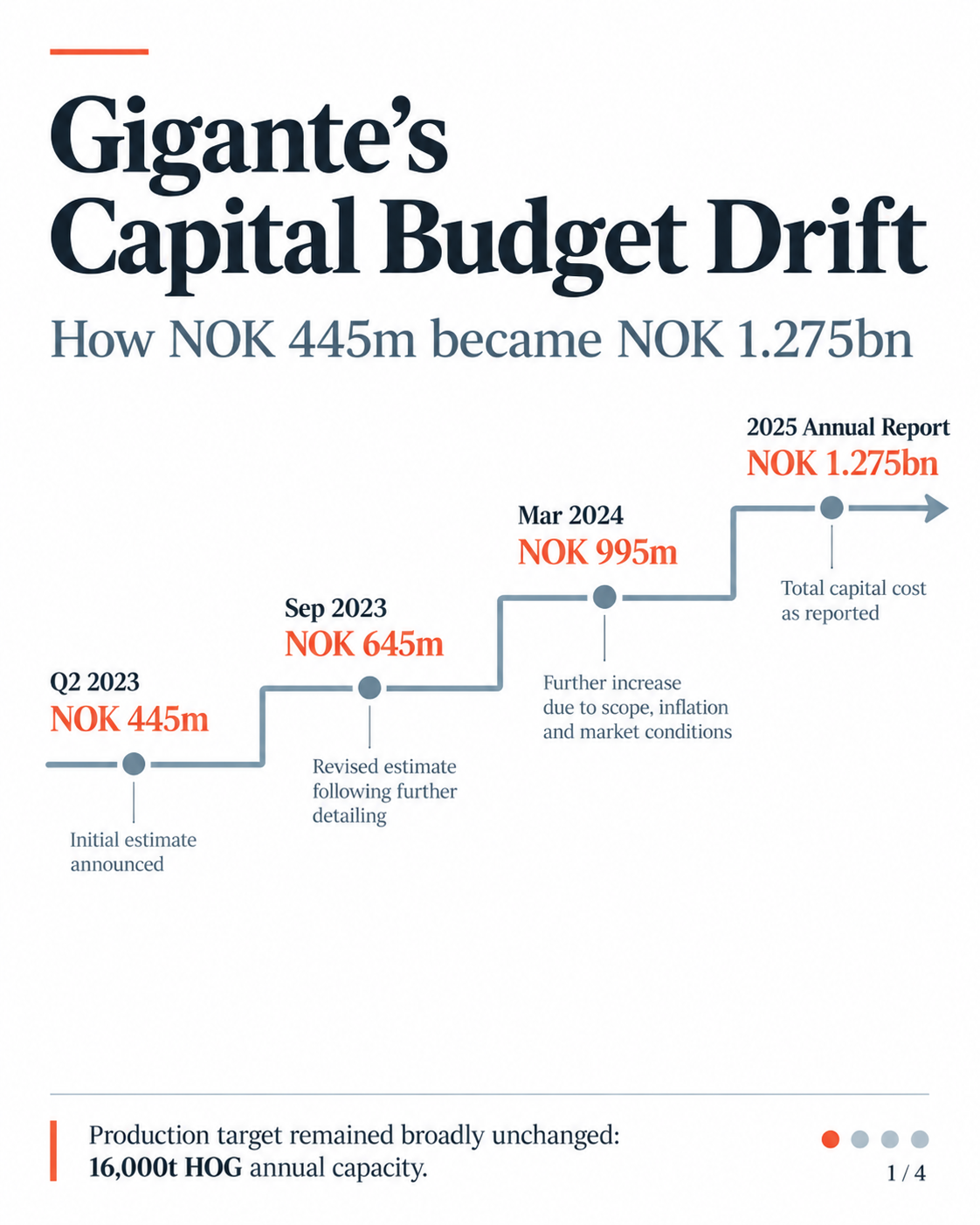
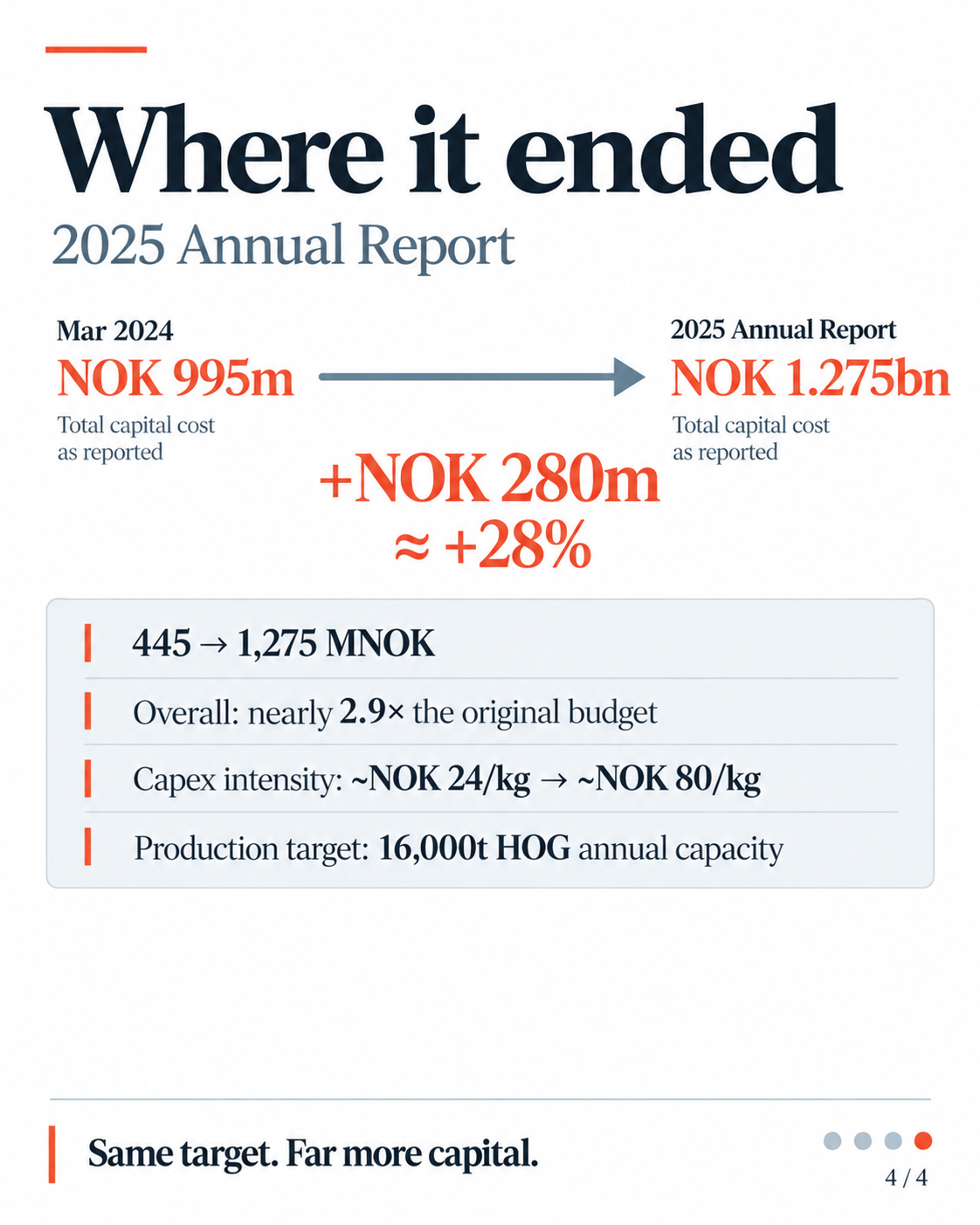
Gigante Salmon provides a useful example. In its 2021 annual report, the company presented a remarkably attractive proposition. A total investment of NOK445 million would create annual production capacity of 16,000 tonnes HOG, which the company expressed as capital expenditure of approximately NOK24/kg of annual production capacity.
That number matters because investors were not simply being offered a salmon farm capable of producing 16,000 tonnes. They were being offered a salmon farm capable of producing 16,000 tons for NOK445 million. Capital efficiency was part of the investment proposition.
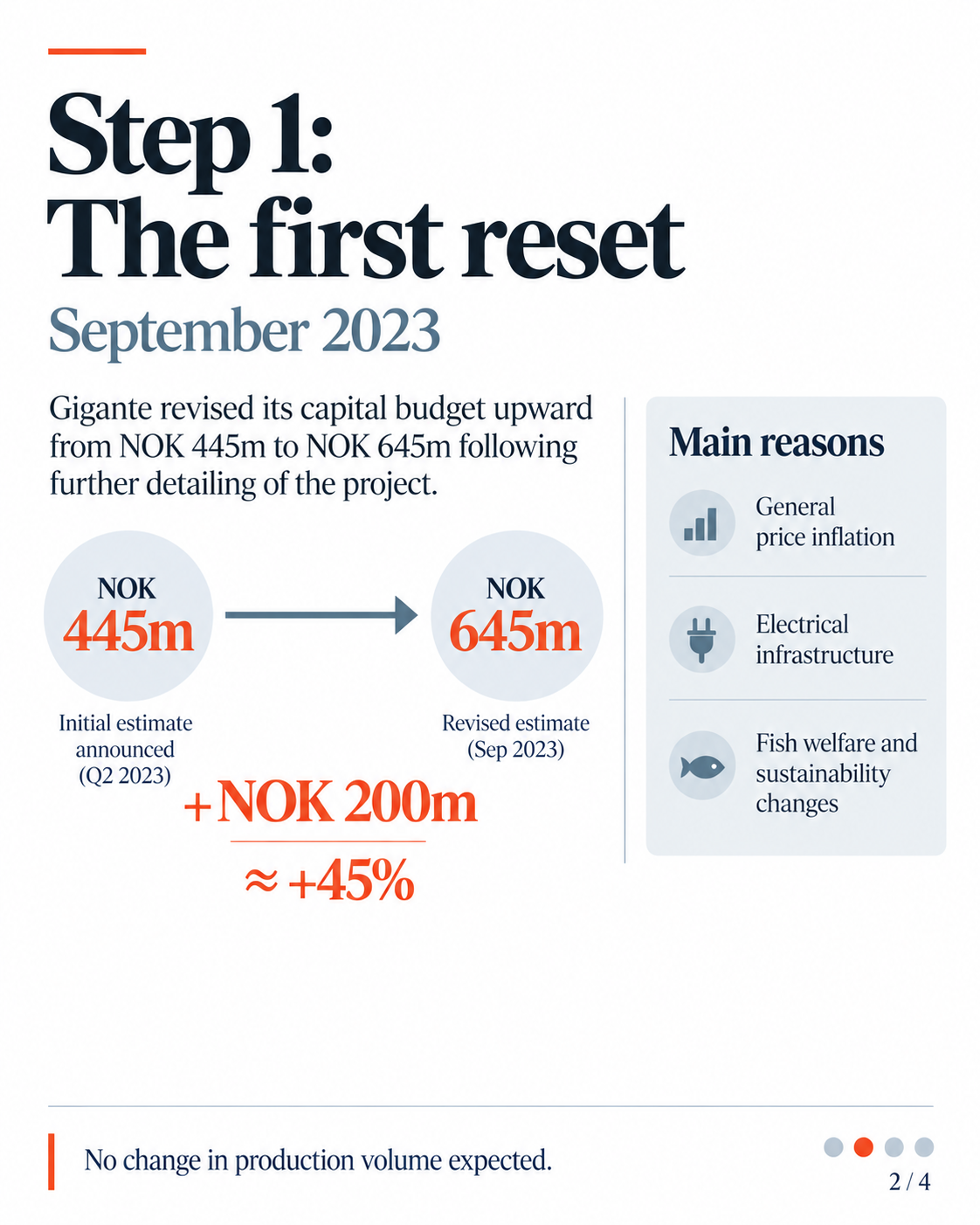
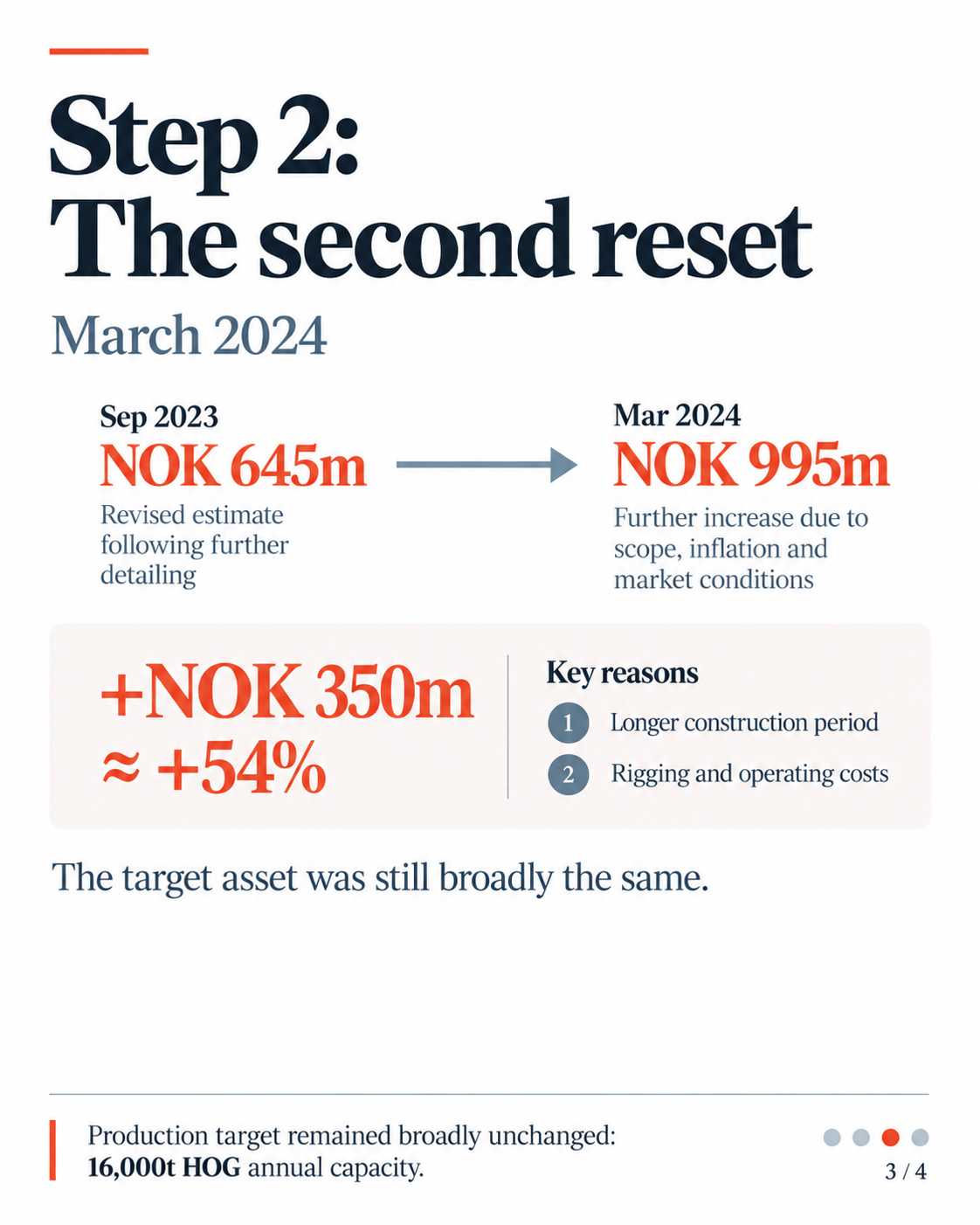
By the 2025 annual report, estimated investment in the facility had increased to approximately NOK1.275 billion, while the production objective remained broadly unchanged at up to 16,000 tons HOG annually.
Using the company's original framing, the change is stark. The investment case started at around NOK24/kg of annual HOG capacity. NOK1.275 billion divided by 16,000 tons is roughly NOK80/kg.
Gigante did not spend three times as much money to build three times as much farm. It spent substantially more money to create broadly the same production capacity originally proposed. For an investor, that is a fundamentally different business.
What is interesting is that capital overruns tend to be treated differently from other forms of underperformance. If production costs remain materially above target, the original cost target still matters. If harvest volumes arrive two years late, the original production timetable still matters. But when construction expenditure increases, attention often shifts remarkably quickly to the latest budget.
The revised budget becomes the new benchmark, and then the next revised budget replaces it. Eventually, the discussion becomes whether the project can be completed within the financing currently available. That is an important question, but it is not the same question investors originally asked.
What is perhaps most remarkable about Gigante's capital escalation is not that investors eventually refused to fund it, but that they repeatedly did. Each additional financing could be justified by the value already sunk into the project and the relatively smaller amount supposedly required to complete it. That is precisely why the original capital benchmark matters. Without it, the question gradually changes from “Is this still the investment we originally funded?” to “Does it make sense to put in a little more money rather than abandon what we have already spent?”
Of course, the original capital budget should not remain frozen forever. Construction inflation matters. Currencies move. Regulatory requirements can change, and projects sometimes evolve in ways that genuinely improve the eventual asset.
An honest assessment of capital delivery therefore needs to rebase the original investment case. The appropriate comparison is not simply original budget divided by actual cost. It is closer to the rebased cost of the originally proposed asset divided by the actual capital required to deliver it.
That distinction separates very different causes of capital growth. If a project costs more because construction prices increased, investors have experienced inflation. If it costs more because equipment had to be replaced, buildings redesigned, contractors remobilised or the construction schedule extended, investors have experienced execution risk. Both require more capital, but they say very different things about project delivery.
That suggests another useful KPI: Capital Budget Delivery.
The concept is simple. Take the rebased original capital budget and divide it by the actual capital required to deliver the intended asset. A project completed for its properly rebased budget scores approximately 100%. A project requiring 25% more capital scores 80%. A project requiring twice the expected capital scores 50%.
This is not intended as a precise accounting measure. Its purpose is to preserve the original investment proposition as a benchmark and force investors to ask why the number changed. Was it inflation? Changed scope? Additional productive capacity? New regulatory requirements? Or was it redesign, delay and rework?
There is another reason this matters. Capital expenditure does not disappear once construction is finished. Additional equity dilutes existing shareholders. Additional debt requires interest and repayment. The assets themselves eventually require maintenance and replacement. Investors need to earn a return on all of the capital employed, not merely the amount originally anticipated.
This is where capital delivery connects directly with the previous two KPIs. A company might ultimately reach its production target. It might ultimately reach its production-cost target. But if achieving those targets requires twice the capital originally contemplated, the investment thesis has changed dramatically.
The farm may work perfectly well. The investment may not.
Development companies inevitably ask investors to look forward: the next construction milestone, the next stocking, the next harvest, the next quarter in which costs should improve. There is nothing inherently wrong with that. Building complex biological infrastructure is difficult and uncertainty is unavoidable.
But investors should periodically look backwards as well. What was supposed to exist by now? What was it supposed to cost to operate? And how much capital was supposed to be required to get here?
Those three questions — Production Ramp Delivery, Cost Ramp Delivery and Capital Budget Delivery — provide a useful framework for evaluating developing aquaculture businesses. None tells you whether the company will ultimately succeed. They tell you how much of the business investors originally agreed to fund has actually been delivered.