

When Optionality Disappears:
How biology forces economic outcomes.
In the farmed salmon sector, high-intensity production systems are often presented as a way to combine the biological and commercial gains of modern aquaculture — improved genetics, mature diets, established processing infrastructure, and developed markets — with a different approach to environmental exposure.
The implicit promise is not necessarily superior biology, but a different risk profile: one that replaces open-environment uncertainty with engineered control.
The central theme of this article series has been that these systems change the shape of risk rather than eliminate it. Biological, operational, and financial uncertainty are redistributed — sometimes into forms that are less visible, but no less binding.
This final article looks at where those redistributed risks ultimately express themselves, and why seemingly rational systems so often converge on similar economic outcomes.
Framing the problem: deviation, not failure
High-intensity aquaculture systems rarely deteriorate because of a single catastrophic event.
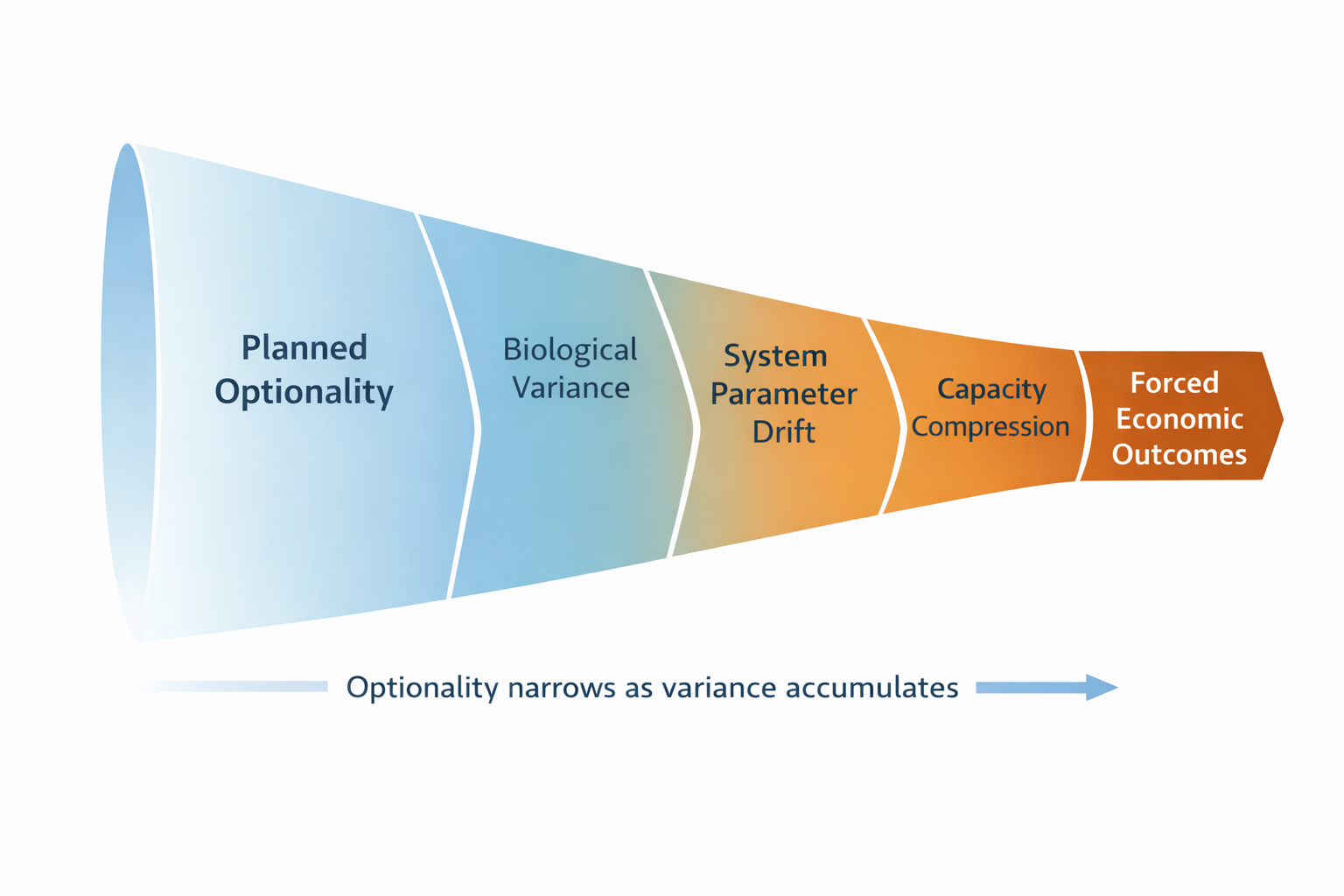
More often, outcomes are shaped by a sequence of modest deviations — in growth, survival, recovery, or timing — that gradually exhaust a system’s ability to adapt. As optionality erodes, decisions that were once flexible become increasingly constrained. From an investor perspective, the important question is not what goes wrong, but which deviations force economic decisions, and how quickly.
The sections below are framed as questions an investor should be able to ask — and have answered — when evaluating capital-intensive aquaculture systems.
1. What happens if growth is faster or slower than plan?
Growth almost never tracks plan exactly.
In systems with limited density headroom and little slack, even modest deviations in growth rate can have outsized consequences.
An investor should ask:
What happens if growth is 5–10% faster than expected?
Where does the additional biomass sit, and for how long?
At what point does faster growth stop being upside and start competing for capacity?
Faster growth increases biomass earlier than modeled. Space fills sooner. Treatment systems operate closer to design limits. Downstream cohorts are compressed.
Slower growth creates a different problem. Fish occupy space longer. Planned harvest windows slide. Younger cohorts wait longer to enter the system.
In both cases, time — not biology — becomes the binding constraint.
2. What happens if survival is materially better or worse than expected?
Survival is often modeled as a point estimate. In practice, it expresses a range.
An investor should ask:
What happens if survival is materially higher than plan?
What happens if survival is materially lower — even in a single cohort or unit?
How quickly can the system absorb either outcome?
Higher survival increases standing biomass. Feed volumes rise. Waste loading increases. Capacity margins narrow — often before fish reach optimal harvest size.
Lower survival relieves crowding but creates economic drag. Fixed costs remain. Depreciation continues. Total production volume declines. Lost biomass is rarely recoverable within the same production cycle.
In constrained systems, biological variance cuts both ways. Upside biology creates pressure. Downside biology carries economic consequences.
3. What happens when recovery takes longer than expected?
In aquaculture, stress is not always the result of a single, identifiable event.
More often, it reflects the cumulative effect of operating conditions that are only slightly off optimal — marginally elevated carbon dioxide, subtle changes in water chemistry, small inefficiencies in waste removal, or prolonged crowding near design limits.
Individually, these factors may appear benign. Over time, their effects accumulate. Growth slows incrementally, appetite softens, feed efficiency deteriorates, and recovery capacity erodes. A chronic stress load develops — often without a clear moment where anything appears to have “gone wrong.”
In that state, even minor disruptions — handling, temperature shifts, brief water quality excursions — can produce outsized consequences.
An investor should ask:
How long does it take for growth, appetite, and feed efficiency to normalize after disruption?
What happens if recovery takes weeks longer than planned?
Does the system have time to reset before downstream cohorts arrive?
In tightly coupled, fully utilized systems, delayed recovery leaves a footprint. Fish remain in place longer than modeled. Feeding rates lag expectations. Space and time are consumed.
When that internally generated variance is forced through a multi-cohort system with little slack, it does not average out. Each deviation consumes space and time, leaving less room for the next.
Recovery that is biologically acceptable may still carry economic consequences.
4. What happens if a single unit is lost or underperforms?
Highly controlled systems tend to localize disruption at the unit level.
An investor should ask:
What happens if a single tank, raceway, or production unit is lost?
How much capacity is immediately unavailable?
Can the rest of the system absorb the shock without compressing other cohorts?
In systems with slack, localized losses remain local.
In systems operating under chronic stress load with little surplus capacity, unit-level disruptions propagate. Cohorts are re-sequenced. Growth plans are altered. Decisions cascade.
The system may continue operating — but with fewer degrees of freedom.
5. What happens when market conditions deteriorate?
Biology does not operate in isolation.
An investor should ask:
What happens if market prices fall below profitable levels?
Is there biological or operational optionality to slow production without penalty?
Can harvest timing be meaningfully flexed — or does capacity pressure force throughput regardless of price?
In high-utilization systems, delaying harvest often increases biological and operational risk. Continuing to harvest may crystallize economic losses.
In either case, market pressure can narrow the range of available decisions.
Why early harvests are not mistakes
Early harvests are often framed as operational failures.
In reality, they are frequently rational responses to constrained systems — a way to relieve pressure, reduce chronic stress load, free capacity, and restore a degree of control.
But they come at a cost.
Early harvests convert biological uncertainty into economic certainty. They lock in smaller fish, lower prices, and permanently foregone growth. Once taken, the decision cannot be unwound.
They are not errors. They are endpoints.
The investor takeaway
The purpose of these questions is not to suggest that any system is flawed, nor that deviations can be engineered away. Variance is inevitable. Biology does not converge to plan.
For investors, the critical issue is whether a system retains enough optionality to absorb that variance — and the gradual accumulation of chronic stress load — without forcing irreversible economic decisions.
In high-intensity aquaculture, outcomes are often shaped less by what goes wrong than by how little slack remains when something inevitably deviates from plan.
That is one of the ways biological risk ultimately expresses itself — not as catastrophe, but as constraint.