

Capacity, Cohorts, and the Role of Slack
Why efficiency and resilience are not the same thing.
In aquaculture, overlapping production cohorts are often framed as a sign of operational maturity.
Multiple cohorts smooth harvest profiles, enable continuous supply, and improve asset utilization. From an investor’s perspective, they look like an efficiency gain — a way to turn biological production into something that behaves more like an industrial process.
That intuition is broadly correct.
What’s less well understood is how the same multi-cohort structure behaves very differently depending on where those cohorts live, and how much slack the system is designed to carry.
Multi-cohort production is not the differentiator
Both open net pen producers and producers operating intensive systems operate with multiple cohorts in parallel.
Fish are stocked at different times, grow at different rates, and are harvested on overlapping schedules. At a high level, this looks similar across systems — and that surface similarity often obscures a deeper structural difference.
The distinction is not whether cohorts overlap. It’s how that overlap is accommodated.
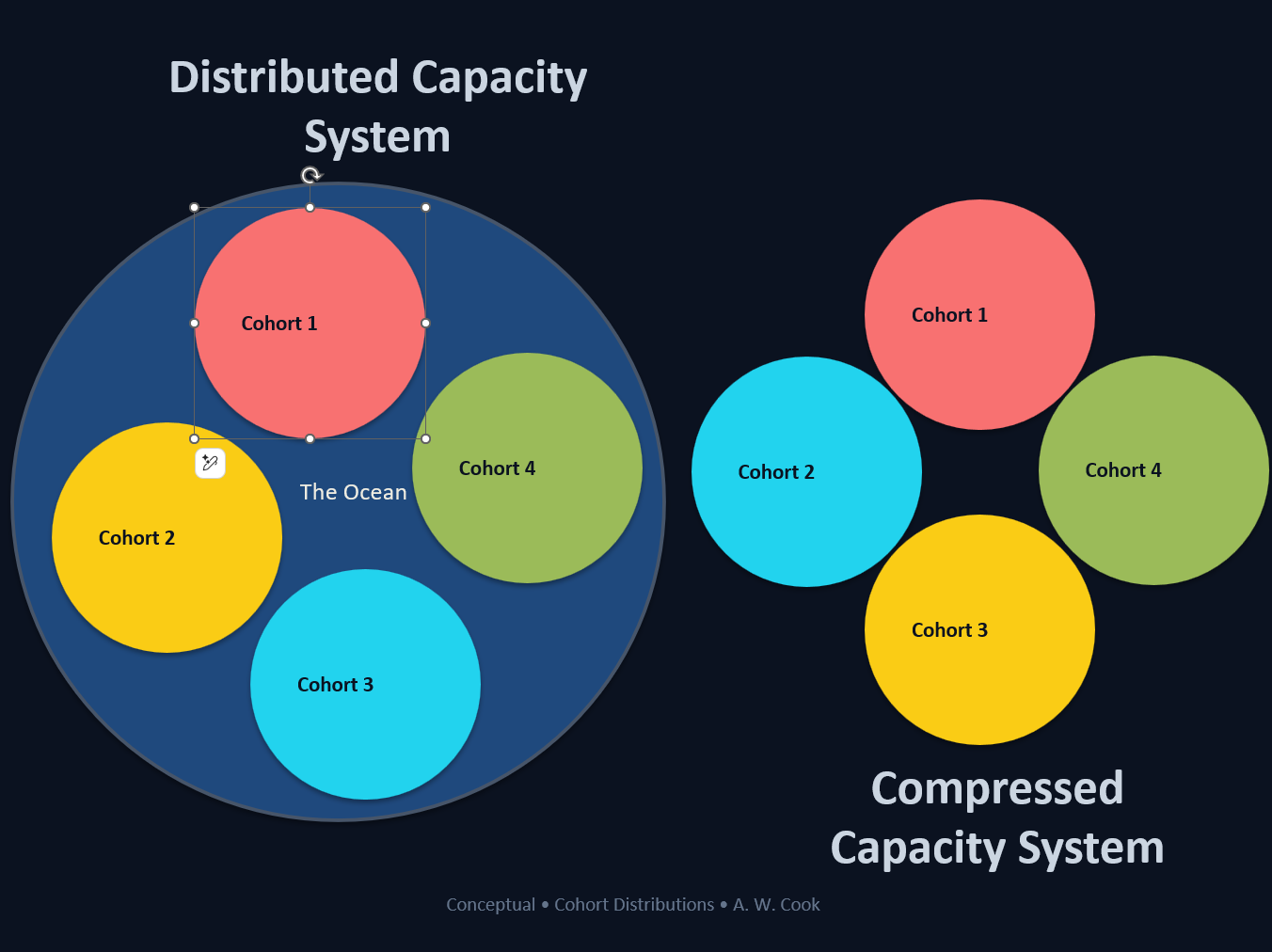
Distributed overlap versus compressed overlap
In open net pen systems, overlapping cohorts are typically distributed geographically.
Farms are separated across fjords, bays, or regions. Biosecurity protocols and fallowing requirements force periods of downtime. Stocking and harvesting are staggered not only in time, but in space. The result is a production footprint that is structurally required to carry surplus capacity. Some sites are empty. Some are underutilized. Some are in fallow.
From a narrow efficiency lens, this looks wasteful. From a system perspective, it creates slack.
That slack absorbs variance — biological, environmental, and operational — without forcing immediate decisions elsewhere in the system.
Intensive systems invert the logic
High-intensity systems, regardless of location, go in the opposite direction.
Capital intensity is high. Infrastructure is fixed. Water treatment, energy systems, and staffing are sized to match expected production as tightly as possible. Every cubic meter not producing fish represents sunk cost without revenue. As a result, surplus capacity is treated as inefficiency — and is systematically stripped out of the design.
Multi-cohort production still exists, but it is compressed into a tightly engineered space where all cohorts share the same physical and operational constraints. This is not a design flaw. It is a design necessity.
Without high utilization, the economics don’t work.
The probability problem
Once multiple cohorts are running simultaneously inside a fully utilized system, variance stops being hypothetical.
Each cohort carries its own uncertainty:
Survival
Growth rate
Recovery from stress
Timing relative to downstream cohorts
Individually, deviations may be absorbed. Across multiple cohorts, the probability of material deviation rises sharply.
With four overlapping cohorts, the probability that at least one deviates materially from plan approaches certainty. That is not pessimism — it is arithmetic.
In systems with slack, those deviations dissipate. In systems without slack, they compete for the same space.
Why aquaculture is not a steel mill
High utilization is often defended by analogy to other capital-intensive industries — steel mills, data centers, power plants — where running “hot” is a feature, not a flaw. The difference is that industrial systems primarily experience external variance: demand cycles, pricing, or input costs. The physical asset itself behaves predictably when operated within design limits.
Biological systems generate variance internally and continuously, even under perfect execution. Growth, survival, stress response, and recovery never converge to a single outcome — they express a distribution. When that internally generated variance is forced through a fully utilized, multi-cohort system with no slack, it does not average out. Each deviation consumes space and time, leaving less room for the next.
Slack is not inefficiency — it’s insurance
This is the point investors often miss.
Net pen systems appear inefficient because regulation, geography, and biology force them to carry unused capacity. But that unused capacity functions as an insurance mechanism.
It allows:
Recovery without immediate intervention
Localized failure without systemic consequence
Re-sequencing of production without cascading effects
Intensive systems deliberately give up that insurance to achieve capital efficiency. That trade-off is real, rational, and unavoidable.
What matters is recognizing what replaces it — and what happens when variance has nowhere to go.
Why utilization feels safe — until it isn’t
High utilization is attractive in models because it looks stable.
Standing biomass is predictable. Harvest schedules are smooth. Unit costs appear optimized. From a distance, multi-cohort operation looks like a way to tame biological variability.
In practice, it does the opposite.
When everything is running at once, deviations stop being local. They become system-wide constraints. Adjusting one cohort affects the others. Recovery options narrow. Time becomes the scarcest resource.
The system doesn’t break. It simply loses optionality.
This is not a critique — it’s a constraint
None of this implies poor planning, weak execution, or flawed management. Multi-cohort, high-utilization designs are a rational response to the economics of intensive aquaculture. They are often the only way to make the numbers work.
But they change the shape of risk.
They trade environmental exposure for internal compression. They trade slack for utilization. They trade optionality for efficiency. Those trades are rarely explicit in investor narratives — but they matter.
Looking ahead
When variance collides with a system that has eliminated slack, decisions are no longer optimized — they are forced.
That is when biology stops being an abstract risk factor and starts dictating economic outcomes.