

Where Should the Next Aquaculture Dollar Go?
Peru’s anchovy problems are already generating the obvious questions: what happens to fishmeal and fish-oil prices, how much will feed costs increase, and which producers will be hit hardest?
Those questions matter. But Peru is not operating in a vacuum.
ICES has recommended a dramatic reduction in Northeast Atlantic mackerel catches for 2026. Morocco has faced enough pressure on sardine availability to close important fishing areas and restrict exports. These are different stocks, in different oceans, facing different biological pressures. They are not evidence of a synchronized collapse in global forage-fish resources.
They do, however, provide important context.
One of the world’s most important sources of fishmeal and fish oil is having an extremely poor year at a time when several other important sources of marine protein, oil and whole pelagic fish are also showing signs of constraint. There is no obvious reservoir of cheap, abundant marine supply waiting to fill every gap.
For anyone already invested in aquaculture, the immediate implications are relatively straightforward.
Costs will increase.
The impact will vary considerably between species. Modern salmon feeds use relatively little fishmeal but remain important consumers of fish oil. Shrimp still uses significant quantities of fishmeal. Tuna ranching remains directly dependent on whole oily fish. Tilapia uses very little marine material at all but may get squeezed on the alternatives.
For an existing producer, the important question is whether the customer can absorb the increase.
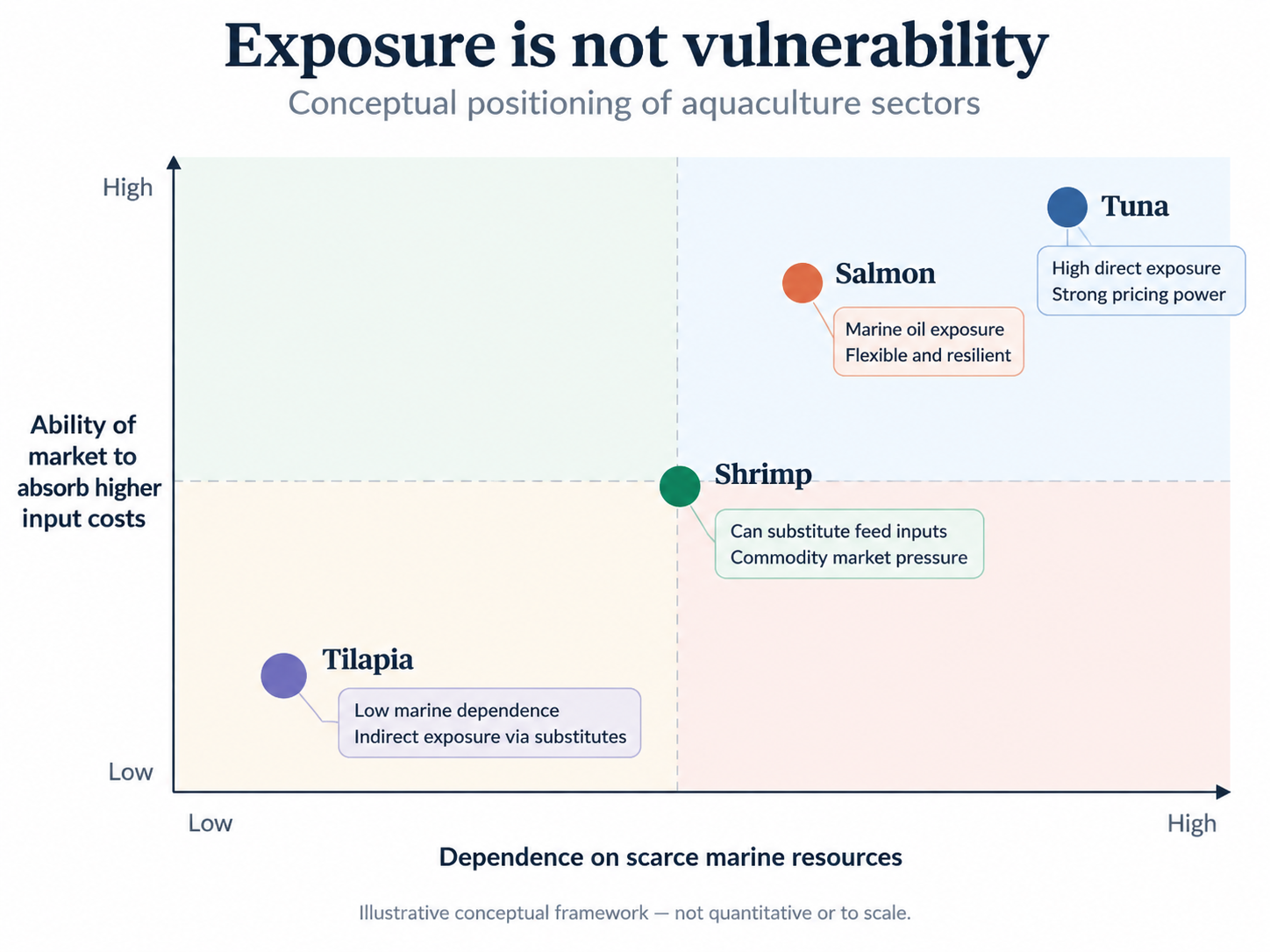
For new money, the questions get more interesting
For an investor considering a new aquaculture investment, near-term feed inflation is only one part of the equation.
A twenty-year investment thesis should probably assume that Peru will not be the last resource constraint the industry faces. Sometimes the constraint will be fishmeal or fish oil. At other times it may be alternative proteins, freshwater, energy, suitable farming locations or regulatory access to production.
The more useful questions are therefore broader.
How resilient is the production system when an important input becomes scarce?
How much additional production can realistically be created?
What kind of market will that production enter?
And what does it cost to become a participant in the first place?
Those four questions produce very different answers across aquaculture.
| Sector | Resilience to feed-resource scarcity | Long-term supply growth | Market dynamics | Cost of entry |
|---|---|---|---|---|
| Tuna | Highly exposed to whole oily fish, but extraordinary product value provides substantial ability to compete for scarce supply. | Expansion is constrained by access to the underlying wild resource and tightly controlled production capacity. | Premium markets provide exceptional pricing power, but the addressable market is comparatively narrow. | Access is difficult and existing production rights and infrastructure create formidable barriers to entry. |
| Salmon | Very flexible on protein and strong enough economically to compete for the marine oils it still needs. | Conventional production growth is increasingly constrained across most established farming regions. | Deep global demand and strong consumer acceptance provide substantial capacity to absorb higher costs. | Scarce licences and high asset valuations mean investors already pay heavily for these advantages. |
| Shrimp | Meaningful fishmeal exposure, but considerable ability to reformulate toward alternative proteins. | Production can expand relatively quickly and in many geographies. | Huge global market, but ease of supply growth creates recurring oversupply and commodity-price pressure. | Capacity can generally be added much more cheaply than salmon or tuna, although biological and market risk remain high. |
| Tilapia | Very low direct marine dependence, although competition for alternative proteins can transmit scarcity indirectly. | Considerable potential for additional production in many developing markets. | Large affordable-protein markets offer substantial volume potential, but limited consumer pricing power. | Relatively low capital and resource barriers can make incremental production considerably easier to create. |
Twenty years ago, salmon ticked almost every box
Twenty years ago, this framework would have pointed strongly toward salmon.
Demand was growing. Production had substantial room to expand. Feed efficiency was improving. Salmon generated enough value to outbid lower-value users for scarce marine ingredients, while feed development steadily reduced the amount required. It combined input resilience, market upside and production growth and investors could participate in that growth at valuations that still left considerable upside.
Most of salmon’s operating advantages remain today. In some respects they have strengthened. The industry is less dependent on marine protein than it was twenty years ago, feed conversion is excellent and the product retains strong global demand.
What has changed are the growth and entry sides of the equation.
Conventional salmon production is constrained in most major producing regions. Additional biological capacity and licenses are scarce. Existing assets command high valuations. Attempts to create large amounts of new supply outside the traditional farming model have repeatedly demonstrated how quickly capital requirements can escalate. Growth is even more challenging in tuna.
Salmon and tuna may still be the aquaculture sectors best equipped to withstand increasingly expensive inputs. That does not necessarily make them the most attractive place to put new money.
The more interesting comparison may therefore be with sectors that have weaker economics today, but substantially more room to grow.
Tilapia lacks salmon’s pricing power. Rising feed costs can be much harder to pass through when the product is being sold specifically as affordable animal protein.
But tilapia also starts with very low dependence on constrained marine resources, can generally add production without purchasing extraordinarily valuable production rights, and serves markets where both fish consumption and production still have substantial room to expand.
Shrimp offers yet another combination: enormous global demand, relatively low barriers to creating new capacity and considerable feed flexibility, offset by the recurring risk that production can grow faster than the market can absorb it.
None of this makes tilapia or shrimp inherently better investments than salmon.
It means the comparison has changed.
Twenty years ago, the aquaculture sector offering some of the strongest operating economics was also one of the sectors offering the clearest production-growth opportunity.
Today those two things may no longer point in the same direction and it is worth asking if the better long-term opportunity lies somewhere else.