

The 2029 BC Net-Pen Ban is already here.
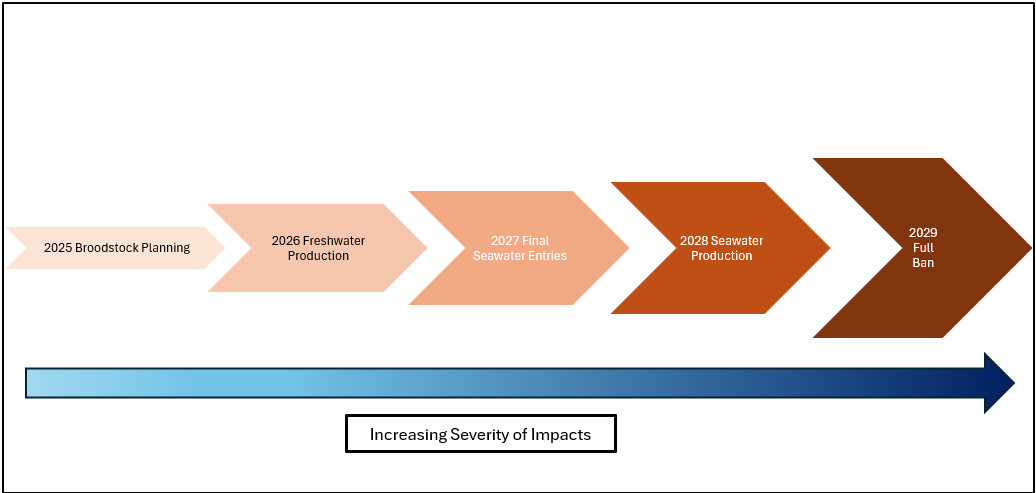
Canada’s planned ban on net-pen salmon farming in British Columbia is normally discussed as a 2029 event. The formal deadline is June 30, 2029. By that date, net-pen salmon aquaculture operations in coastal BC are expected to be fully terminated.
But salmon farming does not operate on political timelines. It operates on biological ones.
A June 30, 2029, deadline may sound distant in policy terms. In production terms, it is already shaping decisions.
An Atlantic salmon production cycle in British Columbia involves roughly 12 months in freshwater followed by ~18 months in seawater. Working backward from June 30, 2029, the final smolt entries into open net pens would need to occur by around the end of 2027. Those smolts, in turn, would need to be in the hatchery around the end of 2026.
But the planning window reaches back even further. Producers must decide well in advance how many broodstock to mature, how many eggs to produce, and how much hatchery capacity to maintain. In practical terms, decisions that determine 2027 smolt availability may have been made in 2025.
That is the part of the story I do not think has received enough attention.
The BC salmon farming ban is already here and is causing employment and economic losses and destroying coastal communities today. Unless companies are prepared to harvest smaller fish or place a risky bet that the policy will change, they are making hard decisions now.
Even if the policy is eventually revised, the effects of uncertainty will not disappear overnight. Production systems cannot be paused and restarted without consequence. Broodstock decisions deferred in 2025 may impact egg supply in 2026 and take years to rebuild. Hatchery capacity left idle or redirected may not be immediately available. Employees, service providers, and suppliers may make their own decisions long before government policy is settled. Capital that has been withheld, written down, or redeployed may not return simply because the rules change.
That is one of the underappreciated costs of regulatory uncertainty. The damage is not limited to the final decision. It accumulates during the waiting period and continues for years even if the policy is reversed.
Production data over the next few years may not reflect poor biological performance, weak prices, or company-specific execution. It may reflect rational planning and resource allocation in response to a fixed policy deadline
None of this settles the policy debate. People can continue to argue about wild salmon risk, First Nations sovereignty, rural employment, food security, closed containment, or the role of federal decision-making in coastal aquaculture. But any serious discussion of the BC ban needs to be grounded in the production calendar.