

Control, Coupling, and the Cost of Managing Everything
Why more control doesn’t mean less biological risk
In discussions about aquaculture risk, control is often treated as an unambiguous positive.
More control is assumed to mean fewer surprises, tighter outcomes, and lower biological risk. Less control is framed as exposure — to the environment, to chance, or to forces outside management’s influence. That framing is incomplete. Control does not eliminate biological risk. It relocates it.
For investors, understanding where risk lives — and how it propagates — matters far more than whether a system appears tightly managed or loosely governed.
Two risk regimes, not two technologies
At a high level, aquaculture systems operate within one of two broad risk regimes.
In an environment-dominated risk regime, the surrounding environment absorbs much of the biological and chemical variability. Operators monitor conditions closely — plankton, oxygen, temperature, lice pressure — but their ability to intervene directly is limited. When things go wrong, the system itself does not fail; performance degrades locally.
In a system-dominated risk regime, those same variables are internalized. Oxygen, carbon dioxide, nitrogen compounds, organic load, and water chemistry are no longer shaped primarily by the environment. They are shaped by the system. Control is higher, but so is responsibility. Deviations must be managed internally, in real time.
These regimes are not better or worse. They simply fail in different ways.
Where net pens actually sit
Open net pen farming sits squarely in the environment-dominated regime.
Operators track a wide range of biological and environmental signals, but in many cases their management options are constrained. They can adjust feeding, redistribute biomass, treat fish, or harvest early — but they cannot easily control plankton blooms, regional disease pressure, or oceanographic conditions.
Crucially, net pen farming manages risk by distributing it.
Biological problems tend to be localized to individual sites or regions. Losses can be severe at the farm level and may influence productivity for years, but they are often absorbed at the portfolio level. Volume is relatively cheap, and poor performance in one location can be offset by normal operations elsewhere.
Net pens do not eliminate biological risk. They accept and amortize it across space and time.
Where intensive systems sit
High-intensity closed or semi-closed systems sit at the opposite end of the spectrum.
Here, control is a design feature. Variables that the ocean normally absorbs are pulled inside the system boundary. Water chemistry, gas balance, and waste processing are no longer externalities — they are operational responsibilities.
This creates optionality. Operators can buffer against many environmental shocks and locate production where open systems are not feasible.
But it also removes an important escape valve.
In these systems, there is no external environment to absorb deviation. When conditions drift, the system itself must correct — quickly and correctly. Failure cannot be localized in the same way. There is no cheap or immediate equivalent of “another site performing well” to offset a struggling unit.
While risk can be distributed across multiple intensive facilities at sufficient scale, the buffering is weaker, slower, and far more capital-intensive than in open systems.
More control increases both upside and obligation.
Three biological clocks
Why does managing everything become so demanding?
Because intensive systems are not managing a single biological process. They are managing three, each operating on a different clock.
Water chemistry responds quickly. Oxygen, carbon dioxide, and some nitrogen compounds can change over minutes or hours.
Fish physiology responds more slowly. Stress, appetite, growth, and immune function unfold over days or weeks.
Microbial systems respond more slowly still. Biofilters, organic load, and microbial community structure have inertia. They adapt, but not instantly — and not always predictably.
These clocks do not tick at the same speed.
Coupling is the real risk amplifier
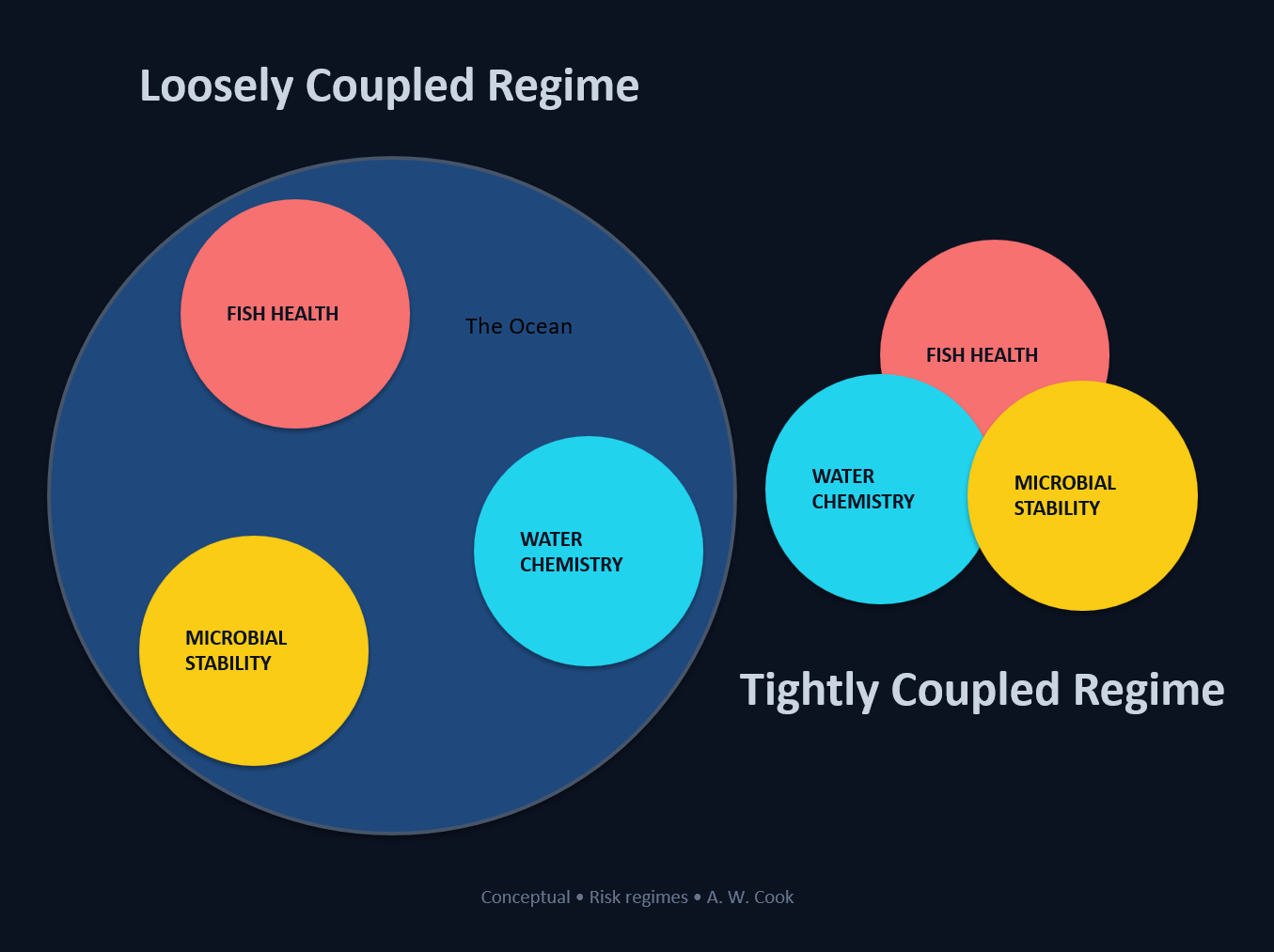
The defining difference between risk regimes is not control itself, but coupling.
In open systems, the environment loosely couples these biological clocks. A shock to one layer does not necessarily propagate cleanly to the others. The ocean provides slack.
In intensive systems, engineering tightly couples them. Changes in feeding, biomass, or water chemistry ripple quickly across fish performance and microbial balance. Timing errors matter. Lag matters. The more tightly these systems are coupled, the less forgiving the overall system becomes.
This is not a critique of design. It is a structural reality of operating near biological limits with limited buffers.
Why failure looks — and feels — different
These differences in coupling explain why failure expresses itself differently across systems.
In net pens, biological problems are often chronic and spatially distributed. They can persist for years, influence site productivity, and weigh on returns — but they rarely cascade instantaneously through the entire production footprint.
In high-intensity systems, problems tend to be acute and internally concentrated. When recovery is slow and buffers are thin, small deviations can escalate rapidly, affecting performance across the entire unit.
Neither outcome is benign. They are simply different shapes of risk.
Responsibility, not blame
It is tempting to interpret these dynamics as a question of execution quality.
That would be a mistake.
In high-intensity systems, operational excellence is not a competitive advantage — it is a baseline requirement. Error tolerance is lower not because managers are worse, but because the system has fewer places to hide mistakes.
In environment-dominated systems, execution matters too — but the environment absorbs a portion of the variance, for better or worse.
Control raises the bar. It does not change the laws of biology.
Looking ahead
When systems operate close to biological limits, recover slowly from deviation, and tightly couple multiple biological processes, risk eventually stops being abstract.
It begins to force economic decisions: changes in feeding, stocking, and ultimately harvest timing.
That is where biological and system risk translate directly into financial outcomes — and where investors most often encounter them.