

Recovery Speed: Why Some Aquaculture Systems Bounce Back — and Others Don’t
When investors think about operational risk in aquaculture, they often focus on whether a system works under ideal conditions.
That’s rarely the right question.
No biological forecast is perfect. Growth rates vary, feed intake fluctuates, energy systems fail, staffing changes, and environmental conditions intrude. Deviations from plan are not mismanagement — they are reality.
The relevant question is not whether reality deviates from plan. It’s how the system behaves when it does.
Recovery speed as an investment lens
In the first article in this series, I introduced the idea of Density Headroom Ratio — how close a production system normally operates to the point where fish performance begins to deteriorate.
Recovery speed is the complementary lens.
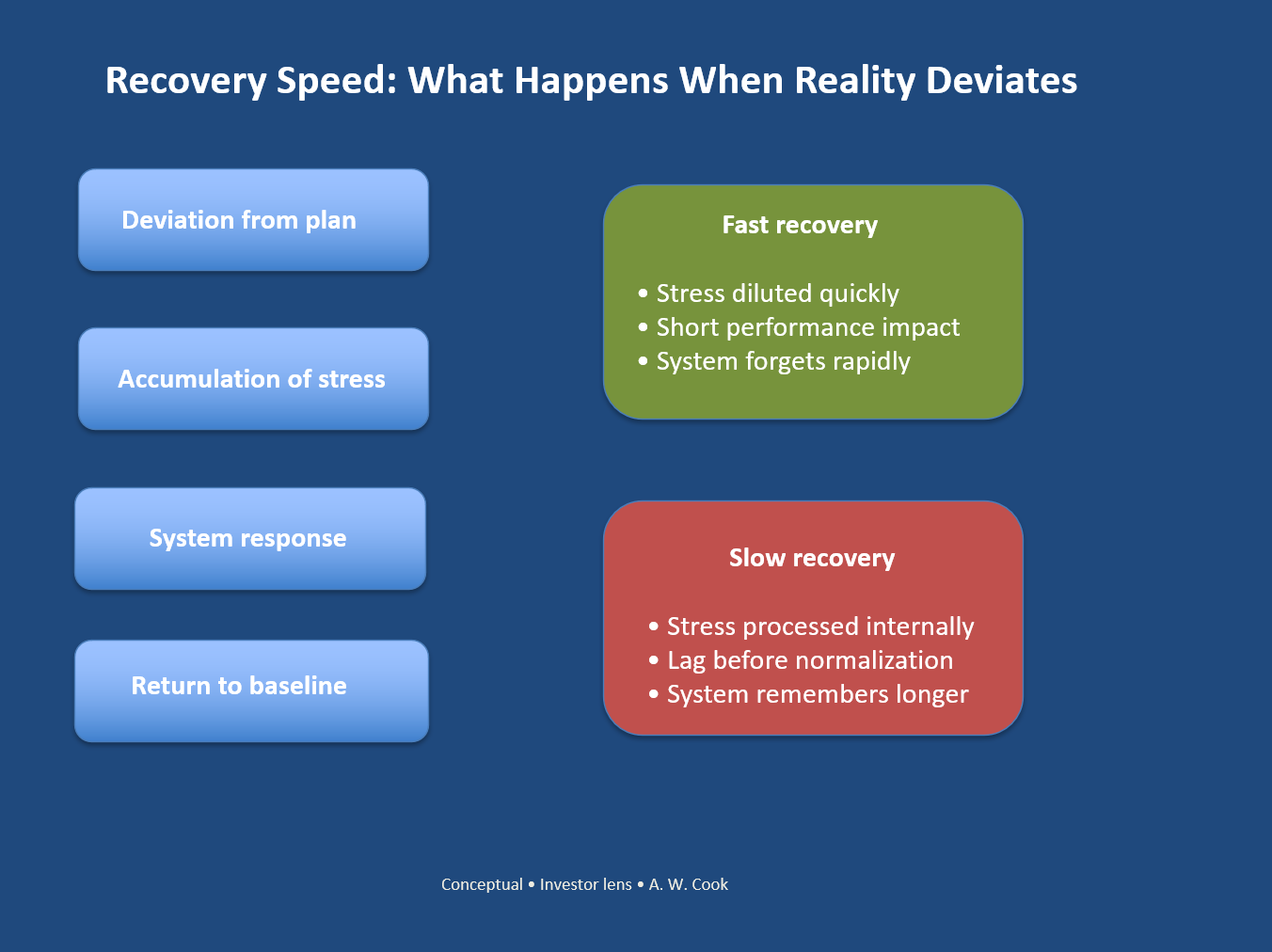
If density headroom tells you how close a system runs to biological limits, recovery speed tells you what happens after those limits are nudged. Two systems can operate at similar densities and face very different risks depending on how quickly small deviations wash out — or compound. Importantly, recovery speed is largely a design constraint, not an execution choice.
Why recovery speed differs between systems
At a high level, aquaculture systems manage biological byproducts in one of two ways.
Some systems rely primarily on dilution — removing accumulated waste and gases by continuously replacing water.
Others rely primarily on transformation — actively processing waste and gases through infrastructure before the system returns to baseline.
Neither approach is inherently superior. They simply fail in different ways. The distinction matters because it shapes how quickly a system can shed stress when conditions drift away from plan.
Water exchange as a proxy for recovery speed
Water exchange rate is a useful proxy for recovery speed.
In dilution-dominant systems, accumulated byproducts can be flushed away quickly if sufficient clean water is available. In highly recirculated systems, only a small fraction of system water may be replaced each day, meaning recovery depends on treatment capacity rather than exchange.
This creates order-of-magnitude differences in how fast systems reset.
That trade-off cuts both ways. High exchange buys recovery speed, but trades it for exposure to intake quality, permitting constraints, and seasonal variability. Low exchange reduces environmental exposure, but concentrates risk inside the system.
Recovery speed is not free — it is purchased either through water access or infrastructure.
When recovery is slow, problems linger
In systems with slower recovery, past conditions matter longer.
Fixing inputs does not immediately restore performance. Carbon dioxide, nitrogen compounds, and organic load do not disappear instantly. Fish respond with lag, and performance may remain impaired even after the apparent issue is corrected.
Some systems forget quickly. Others carry memory.
That memory increases sensitivity to small forecasting errors and raises the cost of deviation.
Where net pens fit into this framework
Open net pen farming also exhibits long biological tails. Disease pressure, site history, and cohort performance can influence results for years.
The difference is where that risk accumulates.
In net pens, biological risk is distributed across many production units and sites. Lingering problems at one farm can be offset by smooth operations elsewhere, supported by the relatively low cost of adding volume. Net pens don’t eliminate biological risk — they distribute it.
Why recovery speed matters to capital allocation
High recovery speed reduces the cost of forecasting errors. Low recovery speed amplifies them.
Neither risk profile is inherently superior, but they behave very differently under stress. Systems with slow recovery require tighter forecasting, wider buffers, and greater tolerance for short-term volatility.
Recovery speed determines whether operational surprises are absorbed — or amplified.
The diligence question that matters
If you are evaluating an aquaculture investment, ask this:
When reality deviates from plan, how quickly does this system return to steady state — and what has to happen for that recovery to occur?
Vague answers should make you cautious. Specific constraints should increase your confidence.